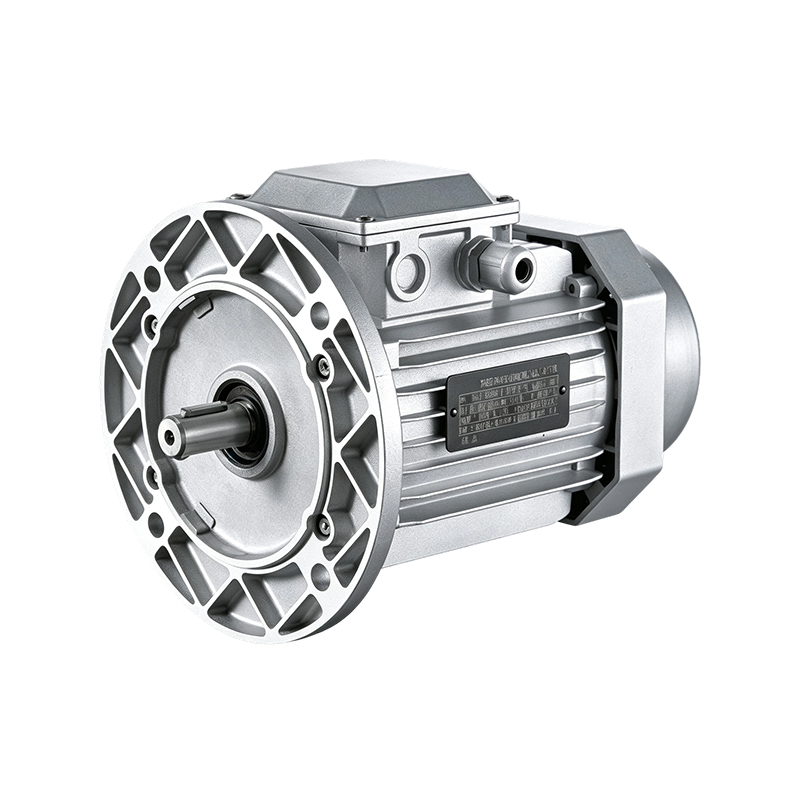
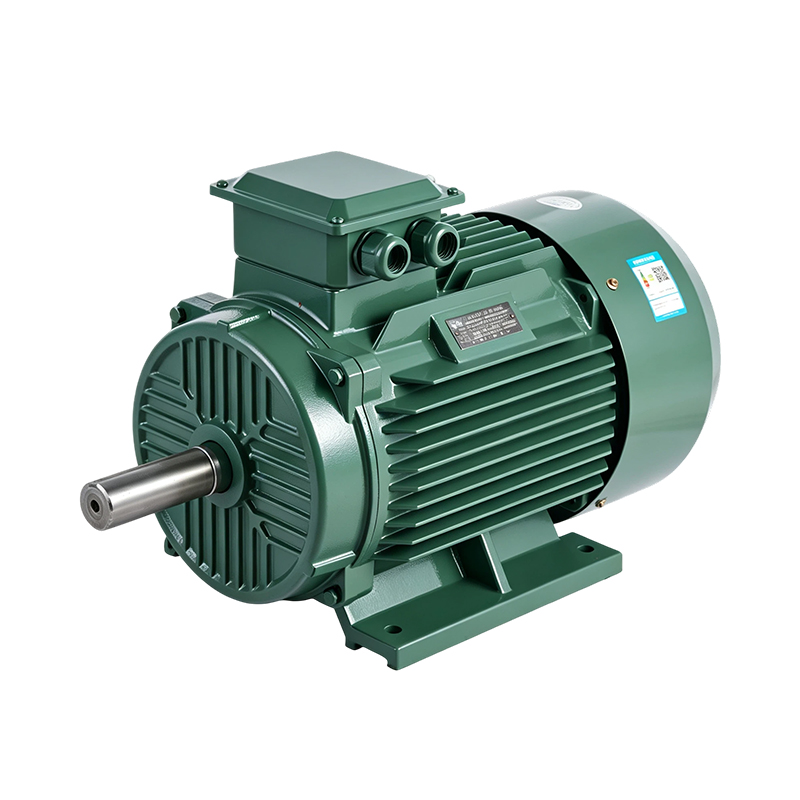
Quickly find the product you need.

A 22 kW pump motor that trips its overload relay every afternoon in August is rarely a motor fault. It is a selection fault. The motor was bought on kilowatts alone, while the real load profile, ambient temperature and starting torque were never written down. The same mistake appears as conveyors that stall at start-up, textile lines that lose speed under load, and mixers that burn out windings inside a season.
Industrial asynchronous motors remain the default drive for those duties because they are simple, robust and inexpensive to keep running. Getting the specification right comes down to four decisions taken before the purchase order is written: efficiency class, pole count, enclosure and duty type. Frame size, mounting, voltage and terminal box position all follow from those four. This guide explains what each decision actually changes on the factory floor.
Content
An industrial asynchronous motor, also called an induction motor, has a stator carrying a three-phase winding and a rotor with no electrical connection at all. The rotating field induces current in the rotor bars, the interaction between that current and the field produces torque, and the rotor settles at a speed slightly below synchronous speed. That difference is the slip, typically 1% to 5% at full load.
Three consequences follow from that design, and they explain why the asynchronous motor still drives the overwhelming majority of pumps, fans, compressors, conveyors, mixers and machine tools in industrial plants:
Construction details change with frame size. Aluminium housings dissipate heat efficiently and suit lighter duties where weight matters. Cast iron frames hold their geometry better under vibration and are the usual choice for heavy, dusty or outdoor installations.
Efficiency is the first decision because it is the one you cannot change once the motor is bolted down. IEC 60034-30-1 sets the international minimum levels for IE1, IE2 and IE3, while IEC TS 60034-30-2 covers IE4. For a 15 kW, 4-pole, 50 Hz motor, the guaranteed minimum full-load efficiencies are approximately 91.0% for IE2, 92.1% for IE3 and 93.4% for IE4.
The percentages look small, and in absolute terms they are. What matters is that the loss difference compounds every hour the motor runs. Take that same 15 kW motor running 4,000 hours a year at 75% load: an IE3 unit draws roughly 12.22 kW at the shaft while an IE2 unit draws about 12.36 kW. The 0.14 kW gap becomes around 590 kWh per year, which at USD 0.15 per kWh is roughly USD 88 of annual running cost avoided.
| Efficiency class | Minimum efficiency | Typical first choice for | Relative purchase price |
|---|---|---|---|
| IE2 | 91.0% | Low running hours, legacy replacement | Lowest |
| IE3 | 92.1% | Most new industrial installations | Moderate |
| IE4 | 93.4% | Continuous duty, high energy tariffs | Highest |
If you want a closer look at how the two top classes compare in real specifications, this breakdown of IE3 versus IE4 motors covers the trade-offs in frame size, cost and retrofit suitability.
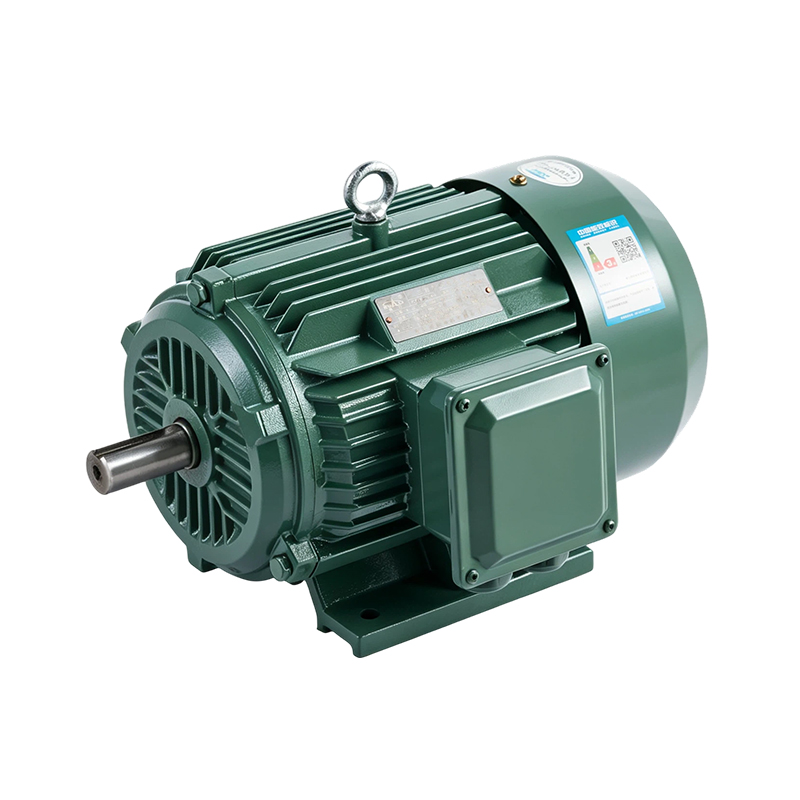 YE3/IE3 High-Efficiency Motors FactoryView More + YE3/IE3 Standard High-Efficiency Induction MotorView Product →
A practical rule: if the motor runs more than 2,000 hours a year, price the IE3 or IE4 option against the energy bill rather than against the IE2 list price. Below that threshold, the premium usually takes longer to recover than the asset's remaining service life.
Pole count is the most common source of specification error, because it changes two things at once. Synchronous speed depends on pole number and supply frequency. At 50 Hz, a 2-pole motor runs near 3,000 rpm, a 4-pole near 1,500 rpm, a 6-pole near 1,000 rpm and an 8-pole near 750 rpm. For the same output power, fewer poles mean higher speed and lower torque; more poles mean lower speed and higher torque in a physically larger frame.
If the driven machine already turns at the right speed without a gearbox or belt reduction, match the pole count to it directly. Direct drive removes belt losses, reduces maintenance and removes a wear item, which is why low-speed direct-drive motors have become common on large fans and extruders.
| Pole count | Speed at 50 Hz | Speed at 60 Hz | Typical driven equipment |
|---|---|---|---|
| 2-pole | ~2,900 rpm | ~3,500 rpm | Centrifugal pumps, fans, compressors |
| 4-pole | ~1,450 rpm | ~1,750 rpm | General machinery, conveyors, mixers |
| 6-pole | ~960 rpm | ~1,160 rpm | Crushers, mills, heavy conveyors |
| 8-pole | ~720 rpm | ~870 rpm | Direct-drive fans, extruders, hoists |
Check starting torque as well as running torque. A loaded conveyor or a positive-displacement pump may need two to three times full-load torque at standstill, and a standard 4-pole motor on a light frame will struggle where a 6-pole or 8-pole heavy-duty frame will not.
Two questions decide the enclosure: how much dust and water can reach the motor, and is there a flammable atmosphere? A totally enclosed fan-cooled (TEFC) motor rated IP55 handles normal indoor conditions and light washdown. Outdoor, coastal or high-humidity installations usually need better sealing, corrosion-resistant fasteners and a condensation drain or anti-condensation heater.
Where a flammable gas or combustible dust atmosphere exists, a standard motor is not an option at any price. Explosion-proof motors are built and certified under the IEC 60079 framework, with flameproof Ex d enclosures designed so that an internal ignition cannot escape, and with defined gas groups, temperature classes and zone suitability. Getting this wrong is a compliance failure, not a performance shortfall, and it usually surfaces during a safety audit rather than at commissioning.
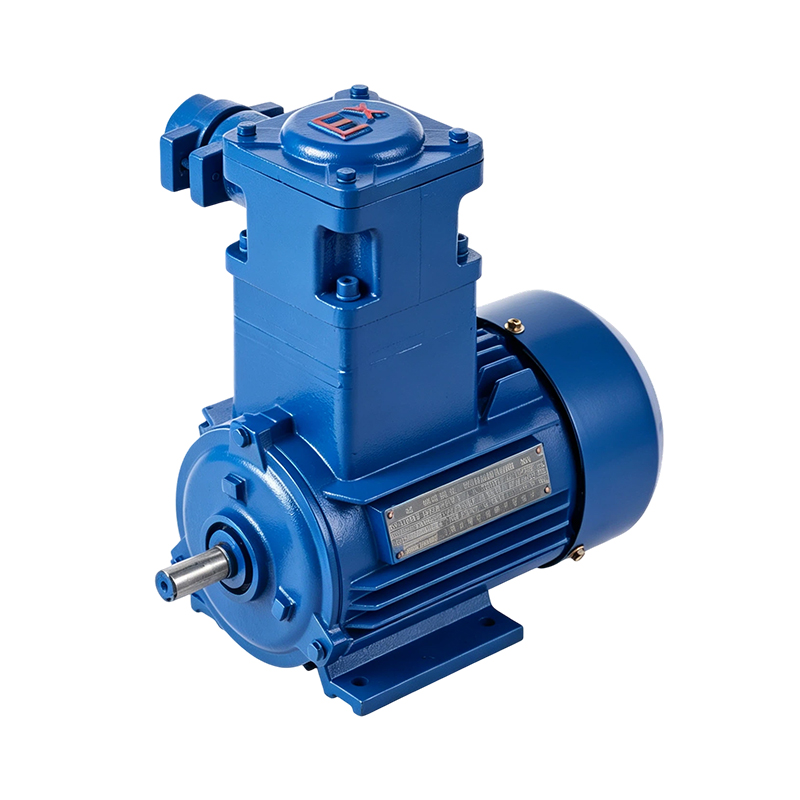 YBX3 Explosion-Proof Motors FactoryView More + YBX3 High-Speed Explosion-Proof Induction Motor (2-pole)View Product →
Ambient temperature and altitude matter too. A motor rated for 40 °C ambient loses usable output above that, and standard ratings assume installation below 1,000 m. If your plant sits at 1,500 m or your process area runs at 55 °C, say so at enquiry stage rather than after delivery.
A standard asynchronous motor connected to a variable frequency drive is not automatically a safe combination. Inverter duty places extra stress on winding insulation and can cause bearing currents, and the shaft-mounted fan stops cooling effectively below about 30 Hz. An inverter-duty motor with class F or H insulation, an independent cooling fan and shaft earthing solves all three issues.
For variable torque loads such as centrifugal pumps and fans, power falls roughly with the cube of speed, so a drive pays for itself quickly on a throttled application. The pump and HVAC duty profile is the classic case: reducing speed by 20% cuts absorbed power by close to half.
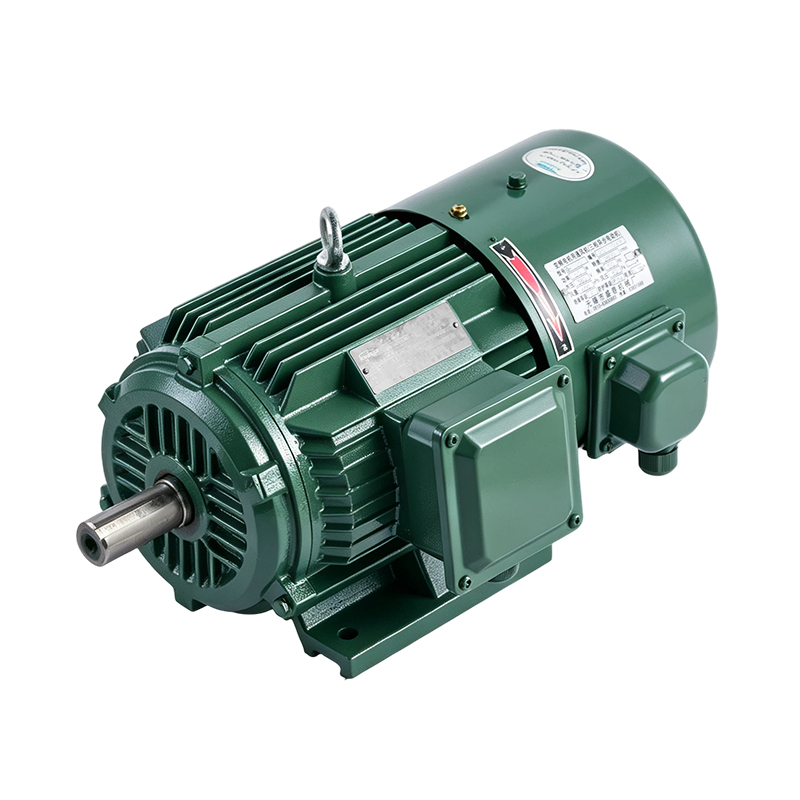 YVF2 Variable-Frequency Motors FactoryView More + YVF2 General-Purpose Variable-Frequency Motor (4-pole)View Product →
Where the load has to hold position, a brake motor replaces an external brake on the driven shaft. A spring-applied, solenoid-released brake holds when power is removed, which is the safe default for hoists, indexing tables and packaging lines. Frequent stops demand attention to brake duty cycle, because brake heating, not motor heating, becomes the limiting factor. And for machine tools or two-speed fans that only need two fixed speeds, a multi-speed motor is often cheaper and simpler than a drive.
Most selection disputes trace back to a missing line in the enquiry. Collect these eight items before the request goes out, and the quotation you receive will be comparable across suppliers:
One closing point on supplier choice. A manufacturer working under an ISO 9001 quality system, with in-house stamping, winding, machining and final testing, can produce the test record for the specific motor on the crate rather than a generic catalogue curve. Ask for that record before the order, not after the failure.
They describe the same machine. "Asynchronous" refers to the fact that the rotor turns slightly slower than the rotating field, which is what allows torque to be produced. "Induction" refers to the rotor current being induced rather than fed by a winding. Industrial asynchronous motor is simply the broader term used for the standard three-phase induction motors found across plants.
Choose IE3 for most general duties and IE4 when the motor runs more than roughly 2,000 hours a year at high load, or where electricity prices are high. IE4 usually comes in a larger or more expensive frame, so check the mounting interface before assuming it is a drop-in replacement.
Start with the speed the driven equipment needs. Centrifugal pumps and fans generally suit 2-pole or 4-pole. Crushers, mills and heavy conveyors usually need 6-pole or 8-pole for higher torque at lower speed. If the machine runs correctly without a belt or gearbox, match the pole count directly and avoid the transmission losses.
It can at moderate speed ranges, but it is not the best choice. Inverter duty stresses winding insulation, may induce bearing currents, and loses cooling below about 30 Hz because the shaft fan slows with the rotor. Specify an inverter-duty motor with appropriate insulation, an independent cooling fan and shaft earthing when the drive is part of the design.
Whenever a flammable gas, vapour or combustible dust atmosphere can be present, including paint booths, solvent areas, grain handling, coal dust and many chemical processes. Explosion-proof motors are certified by zone, gas group and temperature class, so the site classification must be known before ordering. A standard motor cannot be adapted on site to meet these requirements.
Send power, voltage, frequency, phases, pole count or required rpm, mounting type, IP and Ex requirements if any, duty cycle, ambient temperature and the driven equipment. For VFD or brake applications, also state the speed range, brake torque and starts per hour. Complete data usually avoids a second round of technical questions and shortens the lead time.



 English
 Español
 عربى