Quickly find the product you need.

A maintenance team replaces a seized 15 kW pump motor with whatever the storeroom had on the shelf, and the unit that goes in is flameproof: heavier, roughly three times the price of a standard machine, and certified for an area that is not classified. It bolts straight onto the same flange, so nobody questions the cost until the next procurement review.
The mistake is easy to make. "Asynchronous motor" is not a product; it is a family of machines that all share one working principle. The rotor turns slightly slower than the rotating magnetic field, that speed difference is the slip, and the slip induces current in the rotor and produces torque. Everything else — price, starting behaviour, speed, compliance — comes from how the machine is built around that principle.
So here is the answer up front. Industrial asynchronous motors are classified along six axes: rotor construction, supply phase, efficiency class, pole count, enclosure and environment rating, and application-specific features such as braking, variable-speed duty, multi-speed operation and explosion protection. Settle those six and the nameplate writes itself.
Content
The rest of this article takes them one at a time, because in practice a specification error on any single axis is enough to send the motor back.
The rotor is the first and biggest fork in the road. A squirrel-cage rotor is a stack of laminations with aluminium or copper bars running through it, short-circuited at both ends by end rings. There are no brushes, no slip rings and nothing electrical that wears out, which is why the type dominates general industry: pumps, fans, conveyors, compressors and machine tools.
A wound-rotor motor carries a full three-phase winding on the rotor and brings it out through slip rings, so external resistance can be switched in during the start. That produces high starting torque at a controlled current, which is why slip-ring machines still appear on cranes, crushers, mills and long heavy conveyors. The trade-off is real: brushes to inspect, slip rings to clean, a larger frame and a higher purchase price.
If you want the underlying theory first, our explainer on what a three-phase asynchronous motor actually is walks through the rotating field and slip in plain language.
| Feature | Squirrel cage | Wound rotor (slip ring) |
|---|---|---|
| Rotor design | Bars short-circuited by end rings | Three-phase winding with slip rings and brushes |
| Starting torque | Moderate, typically around twice full-load torque | High and tunable via external resistance |
| Starting current | Roughly six to eight times rated current on direct-on-line start | Can be held close to rated current |
| Maintenance | Bearings only | Brushes and slip rings added to bearings |
| Typical duty | Pumps, fans, conveyors, machine tools | Cranes, crushers, mills, heavy conveyors |
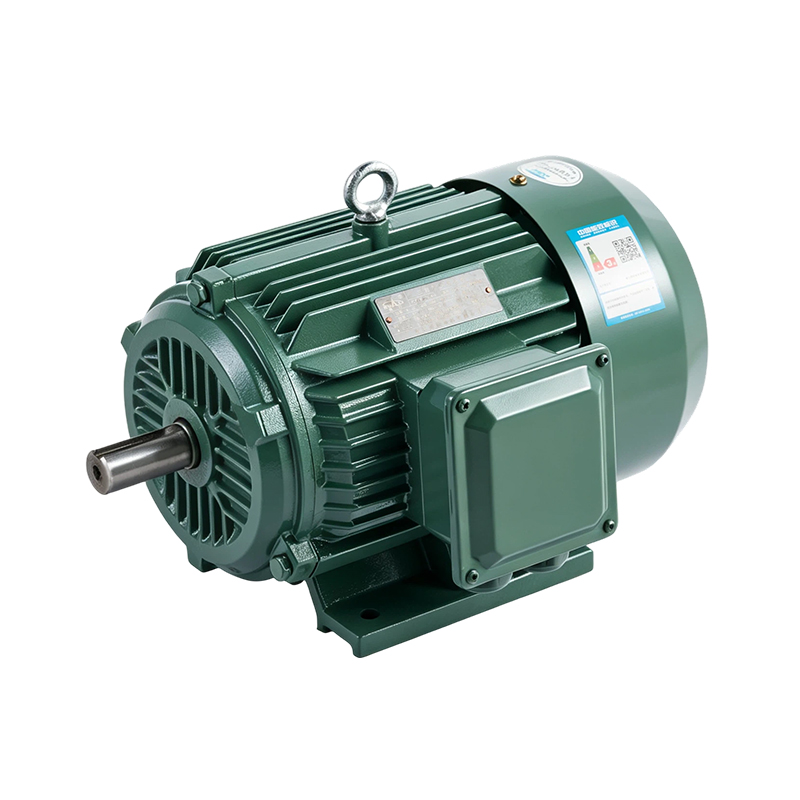
Almost every motor described in this article follows the same layout: a laminated stator core pressed into a finned frame, a three-phase winding sitting in the stator slots, a squirrel-cage rotor on the shaft, and a terminal box on top of the frame.
Two details in that picture decide most selection arguments. The air gap between stator and rotor is well under a millimetre on a 160 frame, so bearing wear, shaft deflection or a misaligned coupling can close it and destroy the motor in minutes. And because the rotor has no electrical connection to the outside, the only parts that normally wear are the bearings.
Single-phase asynchronous motors are starting-limited. With one supply phase there is no rotating field, so a second winding, a capacitor or a shading ring has to create one. The common types are split-phase, capacitor-start, capacitor-start capacitor-run, permanent split capacitor (PSC) and shaded-pole. Capacitor-start delivers the best starting torque, PSC runs more quietly and efficiently, and shaded-pole is cheap and weak, which is why it survives mainly in small fans.
Three-phase motors need none of that. Torque is smoother, efficiency is higher, and the same frame delivers more power. Above roughly 0.75 to 1.1 kW, almost every industrial drive is three-phase, and single-phase machines above that size are a niche product rather than a mainstream choice.
Efficiency is the axis most likely to be audited. IEC 60034-30-1 defines the IE efficiency classes that appear on modern nameplates, and most industrialised markets now enforce a minimum. EU Regulation 2019/1781 covers the majority of new three-phase motors from 0.12 kW to 1000 kW, and China's mandatory GB 18613-2020 maps its grades directly onto the IEC classes: YE3 sits at the IE3 level and YE4 at the IE4 level. The practical consequence is that an unbranded IE2 machine can no longer be legally placed on the market for most duties.
The gap between classes looks small in percentage terms and is not small in money. Take that same 7.5 kW motor running 4,000 hours a year: at IE2 the losses sit near 1.0 kW, at IE3 near 0.8 kW, so the arithmetic gives roughly 850 kWh saved per year. Across thirty motors on a single site that is a budget line, not a rounding error. Actual savings depend on load factor, supply quality and how often the machine is genuinely at full load.
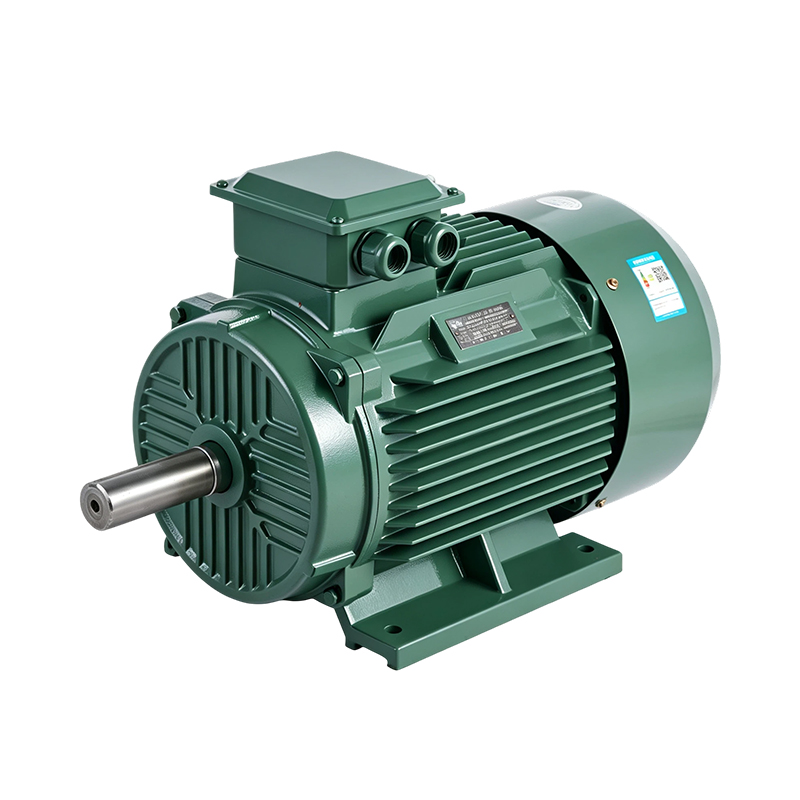 YE4/IE4 Ultra-High-Efficiency Motors FactoryView More + YE4/IE4 High-Speed Energy-Saving Induction Motor (2-pole)View Product →
Synchronous speed follows n = 120f/p, so at 50 Hz a 2-pole motor turns at 3000 rpm, a 4-pole at 1500, a 6-pole at 1000 and an 8-pole at 750. Under load the rotor falls a few percent behind — that is the slip — which is why a 4-pole 50 Hz nameplate usually reads 1450 rpm rather than 1500. At 60 Hz the same motors run about 20 percent faster.
Poles are really a torque decision. Fewer poles means more speed, a smaller frame and less torque per unit of size; more poles means lower speed and higher torque without a gearbox, which suits direct-driven mixers, crushers and slow conveyors. Where the driven equipment needs two fixed speeds — a mixer on a fast and a slow recipe, for instance — a two-speed or four-speed motor can replace a gearbox or a variable-frequency drive entirely.
Two motors with identical electrical data can be completely different products once the environment is considered. The IP code in IEC 60529 covers ingress protection: IP55 is the ordinary industrial default, and it will not survive a regular washdown or a salt-laden coastal atmosphere, where IP56 or IP65 and corrosion-resistant finishes are the realistic starting point. Cooling method matters too — a totally enclosed fan-cooled machine behaves very differently from an open or a pipe-ventilated one.
Ambient and altitude are the quiet specification traps. Standard ratings assume 40 degrees Celsius ambient and 1,000 metres elevation; above either, the motor must be derated or specified with a higher insulation class, and buying the next frame size up is often cheaper than replacing the winding after eighteen months.
Hazardous areas are a separate legal regime rather than a styling choice. In a Zone 1 or Zone 2 gas atmosphere a standard TEFC motor is not acceptable, no matter how well it is built; the certification has to match the zone, the gas group and the temperature class. Flameproof designs such as the YBX3 series are rated Ex d IIC T4 Gb, and the same logic applies to combustible dust, where the relevant protection concept differs.
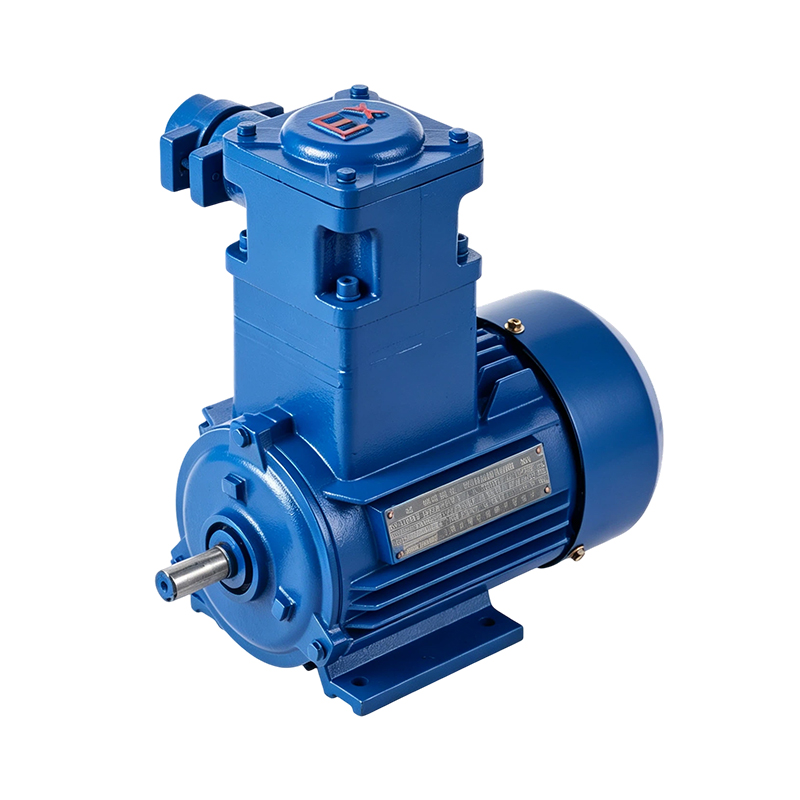 YBX3 Explosion-Proof Motors FactoryView More + YBX3 High-Speed Explosion-Proof Induction Motor (2-pole)View Product →
Once the first five axes are fixed, a small group of purpose-built variants solves problems that a general-purpose motor cannot.
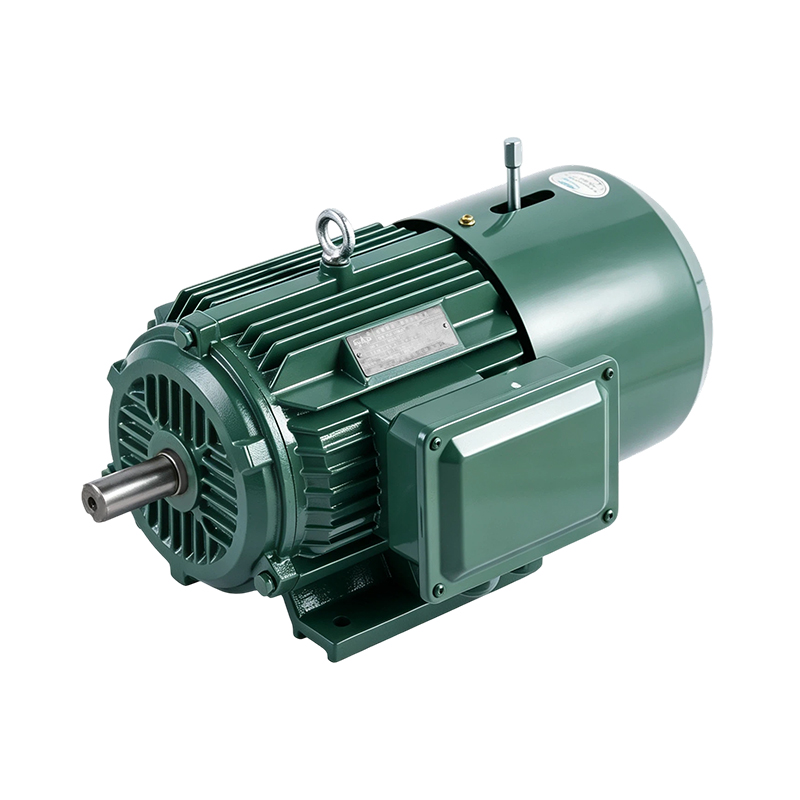 YEJ2 Electromagnetic Brake Motors OEM FactoryView More + YEJ2 High-Cycle Quick-Stop Brake Motor (2-pole)View Product →
The series names on a quotation are usually shorthand for a combination of the six axes. This table maps the common families to the duty each one was designed for.
| Family | Key feature | Typical duty |
|---|---|---|
| YE3 / IE3 | High efficiency, standard and aluminum shell versions | General industry, pumps, fans, compressors |
| YE4 / IE4 | Ultra-high efficiency | Continuous duty where energy cost dominates |
| YBX3 | Flameproof construction | Zone 1 and Zone 2 gas areas, combustible dust |
| YEJ2 | Electromagnetic spring-applied brake | Holding, stopping and positioning |
| YVF2 | Inverter-duty winding and cooling | Constant-torque speed control |
| YVFEJ2 | Inverter duty plus brake | Indexing and rapid positioning |
| YD2 | Two or four discrete speeds | Mixing, fan staging, machine tools |
Most procurement disputes trace back to one of the six axes being left to chance — usually the environment rating or the pole count, because both look like details until the motor is on site. Put the efficiency class, pole count, IP rating, mounting arrangement and starting method in writing before the quotation is issued, and state clearly whether a variable-frequency drive will ever be connected.
If the duty point is unusual, send the load data with the enquiry rather than choosing a frame size from a catalogue table. Our engineers will confirm the type, the frame and the mounting before anything is built — talk to our team about your application and we will come back with a specific recommendation instead of a family name.
They describe the same machine from two angles. "Induction motor" explains how rotor current is produced, by induction from the stator field. "Asynchronous motor" describes the consequence: the rotor must run slower than the field, otherwise no induction would occur. Squirrel-cage and wound-rotor AC motors are both induction motors and both asynchronous motors.
A three-phase squirrel-cage motor: TEFC, IP55, 2-pole or 4-pole, and IE3 or IE4 efficiency. Specify an inverter-duty winding if the pump will be speed controlled rather than switched on and off. Brake or explosion-proof features should only be added when the site genuinely requires them.
They are the international efficiency classes defined in IEC 60034-30-1. IE3 is the current mandatory minimum for most new industrial motors in the EU and China, and IE4 is the next step up. A higher class means lower losses, a higher purchase price and a lower running cost over the life of the machine.
Choose by speed and torque. At 50 Hz, a 2-pole runs near 2900 rpm, a 4-pole near 1450, a 6-pole near 965 and an 8-pole near 725. Pick the fastest option the driven equipment can accept — the frame is smaller and cheaper — and move to more poles when you need torque at low speed or a direct drive without a gearbox.
Whenever it will be installed in a classified area, such as Zone 1 or Zone 2 for gas or Zone 21 and 22 for combustible dust. The motor must carry a certificate matching the zone, gas group and temperature class. A standard IP55 TEFC motor is not a substitute, even if it is physically identical in size.
At or near rated speed, with a short cable run, many standard motors cope. The problem is constant-torque operation at low speed: the shaft-mounted fan slows with the rotor, so the winding overheats, and the inverter's switching adds voltage stress to the insulation. For that duty specify a VFD motor with separate cooling and inverter-grade insulation.



 English
 Español
 عربى