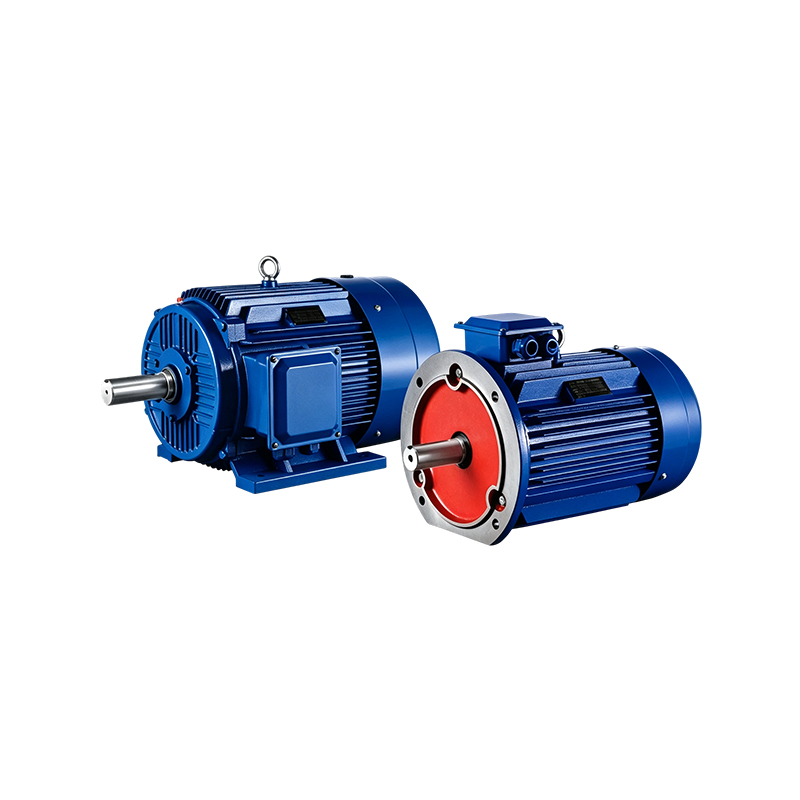
For industrial equipment manufacturers, distributors, and engineering contractors, selecting the right motor is not only about rated power. Speed control, mechanical simplicity, operating cost, installation space, and long-term reliability can directly affect the total cost of ownership. YD2 Multi-Speed Motors provide a practical solution when machinery requires two, three, or four fixed operating speeds rather than continuously variable speed regulation.
A Multi-Speed Motor changes its operating speed through different stator winding connection configurations. Instead of relying entirely on an external electronic speed controller, the motor is designed with specific winding arrangements that allow different pole combinations and corresponding speeds. This makes YD motors particularly suitable for industrial machinery that operates at predefined speed levels.
2. What Is a YD Multi Speed Motor?
(1) Basic Working Principle
YD multi speed motor technology is based on changing the stator winding connection to obtain different numbers of magnetic poles. Since motor synchronous speed is related to supply frequency and pole number, changing the pole configuration changes the motor's operating speed.
For example, at a 50 Hz supply, a two-pole motor has a theoretical synchronous speed of 3,000 rpm, while a four-pole configuration has a theoretical synchronous speed of 1,500 rpm. Actual rated speeds are lower because of slip. This principle makes the YD2 multi-speed motor useful for applications where high and low operating speeds are both required.
(2) Typical Speed Combinations
Depending on winding design, common speed combinations include approximately 750/1500 rpm and 980/1470 rpm at 50 Hz. Three-speed and four-speed configurations can also be engineered for equipment with more than two fixed operating conditions.
Typical relationship between pole number and theoretical synchronous speed at 50 Hz.
| Pole Configuration |
Theoretical Speed |
Typical Application Purpose |
| 2 poles |
3000 rpm |
High-speed operation |
| 4 poles |
1500 rpm |
General industrial operation |
| 6 poles |
1000 rpm |
Lower-speed, higher-torque operation |
| 8 poles |
750 rpm |
Low-speed machinery |
3. How Does a YD Series Multi Speed Motor Work?
(1) Winding Configuration
A YD series multi speed motor is pre-designed with multiple winding connection schemes. Speed switching is triggered externally through a switch, contactor arrangement, or control-panel command connected to the motor terminal box. The selected circuit changes the winding combination and therefore changes the motor's pole configuration and operating speed.
(2) Advantages for B2B Projects
- Simple speed selection: Fixed speeds are easy to integrate into industrial control systems.
- Compact transmission design: A motor can provide multiple operating speeds without necessarily adding a mechanical gearbox.
- Reliable construction: The speed-changing function is integrated into the motor winding design.
- Application flexibility: Two-speed, three-speed, and four-speed solutions can be selected according to equipment requirements.
4. YD2 Multi-Speed Motor Specifications and Selection
For procurement teams, motor selection should consider rated power, voltage, frequency, frame size, mounting arrangement, protection level, insulation class, duty cycle, ambient temperature, and the required speed ratio. The available YD2 multi-speed motor range can cover applications from small machinery to large industrial equipment.
Key purchasing parameters for YD2 multi-speed motor projects.
| Parameter |
Typical Range / Requirement |
Why It Matters |
| Power |
0.45 kW–82 kW |
Matches motor output to machinery load |
| Speed |
Multiple fixed speeds |
Determines machine operating conditions |
| Protection |
IP55 or project-specific option |
Important for dust, moisture, and industrial environments |
| Mounting |
B3, B5, B35, V1 and other options |
Ensures mechanical compatibility |
For OEM buyers, it is especially important to confirm whether the motor must maintain the same rated torque at different speeds or whether the load itself changes with speed. Pumps, fans, machine tools, conveyors, textile machinery, mining equipment, and lifting-related machinery can have very different torque requirements.
5. YD Pole Changing Motor vs. Variable Frequency Motor
A YD pole changing motor and a variable-frequency-drive system solve different speed-control requirements. A YD motor is designed for predefined speed steps, while a VFD can normally provide continuously adjustable frequency and speed within its operating range.
For a machine that only needs two fixed speeds, such as approximately 750/1500 rpm, a YD solution can simplify the electrical architecture. If an application requires frequent acceleration, deceleration, or continuously variable speed, a VFD-based solution may be more appropriate. Therefore, the best selection depends on the actual operating profile rather than simply choosing the most advanced control technology.
6. Applications of YD Series Motor
The YD series motor is suitable for industrial equipment requiring step-by-step speed regulation. Common applications include:
- Machine tools requiring different cutting or processing speeds.
- Mining and metallurgical machinery operating under different load conditions.
- Pumps and HVAC equipment requiring predefined operating stages.
- Textile and printing machinery requiring different process speeds.
- Chemical and process machinery requiring simple step-speed control.
- Port, lifting, conveying, and other heavy-duty industrial machinery.
7. YD Multi Speed Motor Manufacturer and Supplier
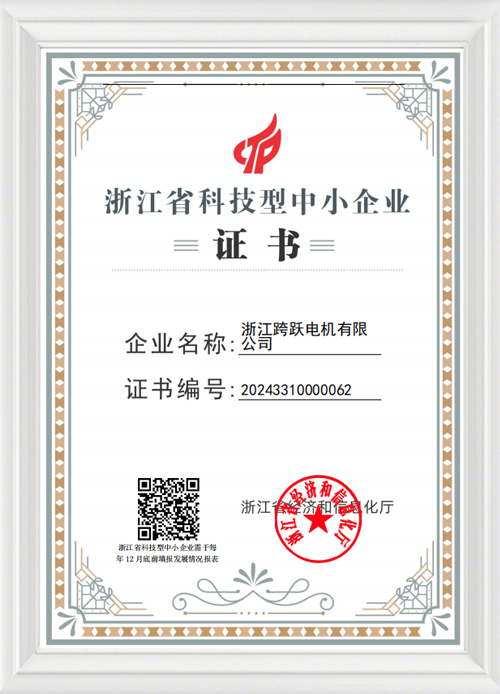
Zhejiang Kuayue Motor Co., Ltd. is an export-oriented manufacturer integrating R&D, production, sales, and export. Located in Luqiao District, Taizhou City, Zhejiang Province, the company has accumulated 34 years of experience in the motor industry. Its production base covers 29 mu and has more than 30 staff members.
YD2 Multi-Speed Motors from the company change the wiring configuration of the stator windings to enable a single motor to output two, three, or even four different speeds. Power output covers 0.45 kW to 82 kW, providing a practical alternative for machinery that needs fixed-speed operation without automatically requiring a separate variable-frequency drive or gearbox.
The motor is pre-designed with multiple winding connection schemes. Speed switching is triggered externally through a switch or control-panel command at the terminal box, changing the winding combination accordingly. Common combinations include approximately 750/1500 rpm and 980/1470 rpm. The speed-changing process is fast-responding and based on the motor's internal winding configuration.
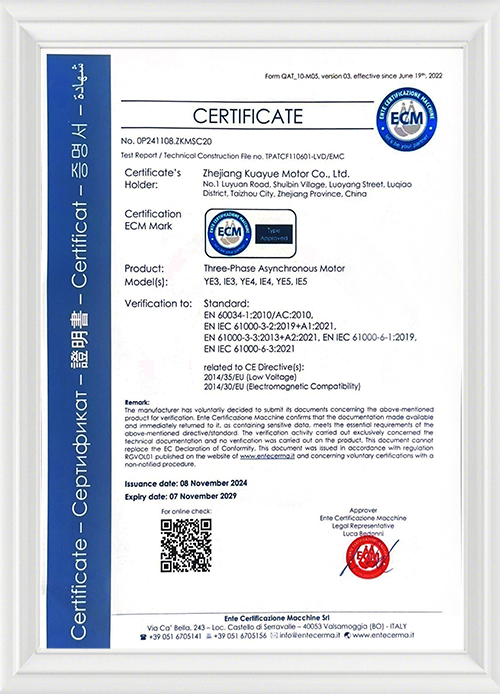
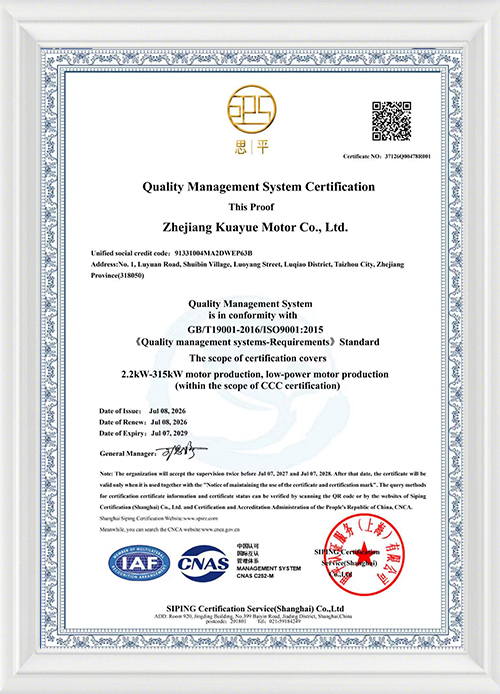
Manufactured under an ISO9001 quality-management system, the company's products hold China CCC compulsory certification and EU CE certification. Its motors are sold across more than 20 Chinese provinces and exported to Europe, America, Southeast Asia, the Middle East, and other international markets, serving mining, chemical, pump and HVAC, textile, lifting, machine-tool, and port-construction machinery sectors.
8. How to Choose a YD Multi Speed Motor Supplier
When purchasing from a YD multi speed motor manufacturer or YD multi speed motor supplier, buyers should evaluate more than the quoted unit price. A reliable B2B supplier should be able to confirm motor specifications, winding configurations, mounting dimensions, terminal-box wiring, protection requirements, certificates, packaging, lead time, and after-sales support.
- Confirm the required number of speeds and exact speed combinations.
- Match rated power and torque with the real mechanical load.
- Check voltage, frequency, phase, mounting arrangement, and frame size.
- Request technical drawings and terminal-box wiring information before mass production.
- Verify certification, quality-control procedures, export experience, and spare-parts support.
9. Frequently Asked Questions About YD Multi-Speed Motors
Q1. What is a multi-speed motor?
A multi-speed motor is an electric motor designed to operate at two or more predefined speeds. In YD motors, different stator winding connections create different pole configurations, allowing the motor to provide multiple fixed operating speeds.
Q2. How does a multi-speed motor work?
A multi-speed motor works by changing the electrical connection of specially designed stator windings. This changes the effective number of magnetic poles and therefore changes the motor speed. External switching equipment selects the required winding configuration.
Q3. What is a two-speed motor?
A two-speed motor is designed to provide two distinct operating speeds. A typical YD configuration may use two pole numbers, such as 4/2 or 8/4. At 50 Hz, the theoretical synchronous speeds for 4 and 2 poles are approximately 1500 and 3000 rpm, while actual motor speeds are lower because of slip.
Q4. What is a three-speed or four-speed motor?
A three-speed or four-speed motor uses more than two predefined winding configurations. These motors are useful when machinery needs several fixed production speeds but does not require continuous electronic speed adjustment. The exact speed combinations should be selected according to the load characteristics and machine design.
Q5. What is a YD motor?
A YD motor is a pole-changing multi-speed three-phase induction motor. The YD series is commonly used for industrial machinery requiring step-speed regulation. Depending on the model, it can provide two, three, or four operating speeds through different winding connection schemes.
Q6. What is a YD2 motor?
A YD2 motor refers to a YD2 series pole-changing multi-speed three-phase induction motor. For B2B purchasing, buyers should confirm the exact frame size, rated power, pole combination, rated speed, voltage, frequency, mounting arrangement, protection level, and terminal-box configuration because specifications can vary between models and manufacturers.
Q7. How does a YD motor change speed?
A YD motor changes speed by switching the stator winding connection. The switching equipment selects a different winding configuration, which changes the number of effective poles. This changes the motor's synchronous speed without requiring the motor itself to operate with continuously variable frequency.
Q8. What is a pole-changing motor?
A pole-changing motor is an induction motor whose stator winding is designed so that its magnetic pole number can be changed. Because motor speed is closely related to pole number and supply frequency, pole changing provides practical step-speed control for industrial equipment.
Q9. What is a Dahlander motor?
A Dahlander motor is a type of pole-changing induction motor that normally obtains two speeds with a 2:1 pole relationship. It is widely associated with two-speed applications. However, not every YD multi-speed motor should automatically be considered a Dahlander motor because YD designs can use different winding arrangements and multiple speed configurations.
Q10. Is a YD2 multi-speed motor better than a VFD?
Neither solution is universally better. A YD2 multi-speed motor is attractive when a machine requires a small number of fixed speeds and simple, robust switching. A VFD is generally more suitable when continuous speed adjustment, controlled acceleration, deceleration, or advanced motor control is required. The correct choice should be based on the machine's speed profile, load torque, control requirements, installation conditions, and total project cost.


 English
 Español
 عربى
عربى