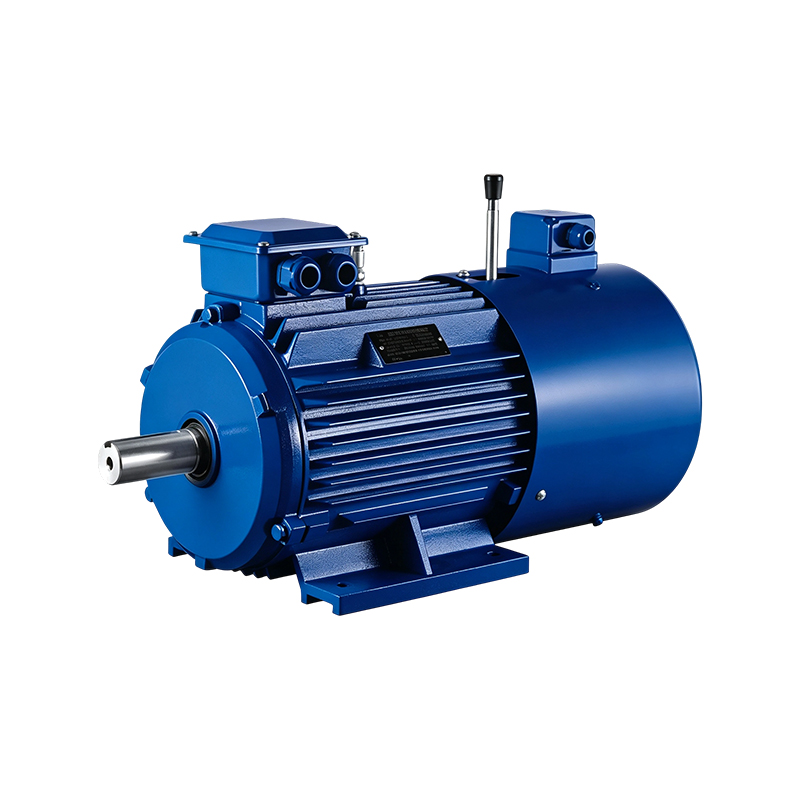
YVF2 Variable-Frequency Motors are designed for applications where conventional fixed-speed motors cannot provide the required speed flexibility. When an electromagnetic brake is added, the motor can deliver both adjustable speed and rapid stopping, making it suitable for conveyors, machine tools, lifting equipment, textile machinery, packaging lines and other industrial systems. Modern variable-frequency motors are commonly paired with electronic inverters to provide controlled acceleration, deceleration and operating speed.
For OEMs and industrial buyers, the key issue is not simply choosing a motor with a brake. The complete system must match the motor rating, VFD output, brake voltage, braking torque, cooling method, duty cycle and mechanical load. For example, a variable-frequency motor intended for continuous low-speed operation normally requires independent forced ventilation to maintain acceptable temperature rise.
(1) Motor and brake working together
A variable-frequency brake motor combines a variable-frequency induction motor with an electromagnetic brake. The VFD controls motor frequency and voltage, while the brake provides mechanical holding or rapid stopping. In a typical spring-applied electromagnetic brake, the brake releases when its coil is energized and engages when power is removed. This fail-safe principle is particularly useful where the load must stop when electrical power is interrupted.
(2) Why businesses choose a brake motor with VFD
- Flexible speed control: production speed can be adjusted without changing mechanical gearing.
- Fast stopping: the electromagnetic brake can provide positive mechanical braking.
- Improved automation: the VFD and brake can be integrated into PLC-controlled sequences.
- Application flexibility: one motor platform can support different production speeds.
3. VFD Brake Motor Wiring: What Engineers Need to Know
(1) Basic VFD brake motor wiring
The most important principle in VFD brake motor wiring is that the motor power circuit and brake circuit must be treated separately unless the manufacturer's wiring diagram specifically permits another arrangement. The three-phase motor terminals connect to the VFD output, while the electromagnetic brake receives its specified supply through the appropriate rectifier, relay or brake-control circuit.
(2) VFD brake motor wiring diagram considerations
A correct VFD brake motor wiring diagram should identify the U/V/W motor terminals, protective earth, brake power supply, rectifier or brake controller, VFD digital output and any interlock circuit. The brake supply should not automatically be assumed to come directly from the VFD output. Many integrated brake motors use a dedicated brake supply so that the brake voltage remains stable even when the VFD changes output frequency.
Typical control functions to verify when integrating a brake motor and VFD.
| Function |
Purpose |
Engineering Check |
| Motor output |
Speed and torque control |
Rated voltage, current and frequency |
| Brake supply |
Brake release and engagement |
Correct voltage and rectifier type |
| Interlock |
Prevent unsafe starting |
Brake status before motor acceleration |
4. Brake Motor VFD Control and Settings
(1) Brake motor VFD control sequence
A reliable brake motor VFD control sequence normally releases the brake before significant motor acceleration and applies the brake only after the motor has decelerated to a suitable condition. The exact sequence depends on the machine, load inertia and manufacturer's recommendations. For lifting equipment, the control logic is especially important because premature brake release or delayed brake engagement can create dangerous load movement.
(2) Brake motor VFD settings
Important brake motor VFD settings include motor rated voltage, rated current, base frequency, acceleration time, deceleration time, minimum frequency and braking-related digital outputs. VFD manufacturers may also provide DC injection braking or controlled stopping functions. These functions should not be treated as a replacement for a mechanical electromagnetic brake when positive holding is required. For example, a VFD may slow a 4-pole motor from approximately 1,500 rpm at 50 Hz to zero, while the mechanical brake provides the final holding force.
5. Variable Frequency Brake Motor Selection for B2B Projects
(1) Key selection parameters
- Motor output power and rated current.
- Rated voltage and operating frequency.
- Required speed range and low-speed torque.
- Required static and dynamic braking torque.
- Brake voltage, release time and braking frequency.
- Cooling arrangement for continuous low-speed operation.
- Mounting configuration, shaft dimensions and protection rating.
(2) Example for equipment manufacturers
Suppose a conveyor requires 7.5 kW at 50 Hz but must operate at several production speeds. A YVF2-based brake motor can be matched with a VFD so the machine does not need to run continuously at full speed. If the application also requires rapid stopping, the electromagnetic brake provides a dedicated braking function. The final selection should be based on actual load torque, inertia, stopping frequency and required safety performance rather than motor power alone.
6. YVFEJ2 Variable-Frequency Brake Motors from Kuayue Motor
YVFEJ2 Variable-Frequency Brake Motors combine the YEJ2 electromagnetic brake series with the YVF2 variable-frequency series. An electromagnetic brake is mounted on the non-driving shaft end of the YVF-series motor, enabling the equipment to achieve stepless speed regulation within a range of 150~2750 RPM — just like a standard variable-frequency motor — while also delivering fast braking capability the instant power is cut. This makes it a dedicated solution for applications with simultaneous “speed regulation” and “braking” requirements.
Kuayue Motor Co., Ltd is YVFEJ2 variable-frequency brake motor manufacturer and OEM factory in China, offering custom variable-frequency brake motor solutions for industrial applications.
Zhejiang Kuayue Motor Co., Ltd. is an export-oriented manufacturer integrated with R&D, production, sales and export, located in Luqiao District, Taizhou City, Zhejiang Province. The company has accumulated 34 years of experience in the motor industry. Its production base covers 29 mu with more than 30 staff members.
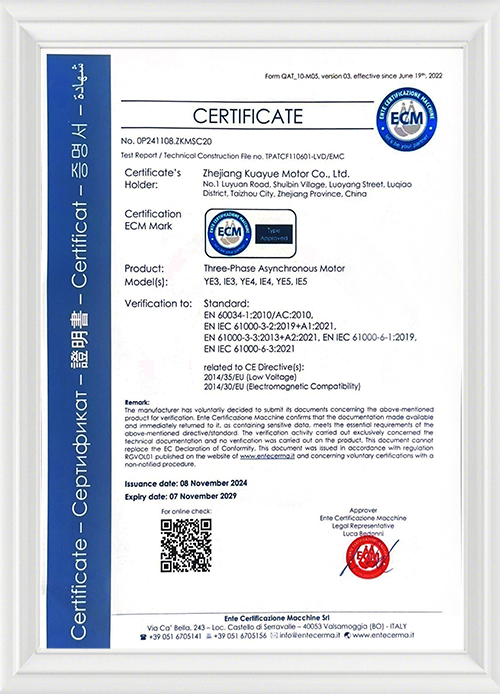
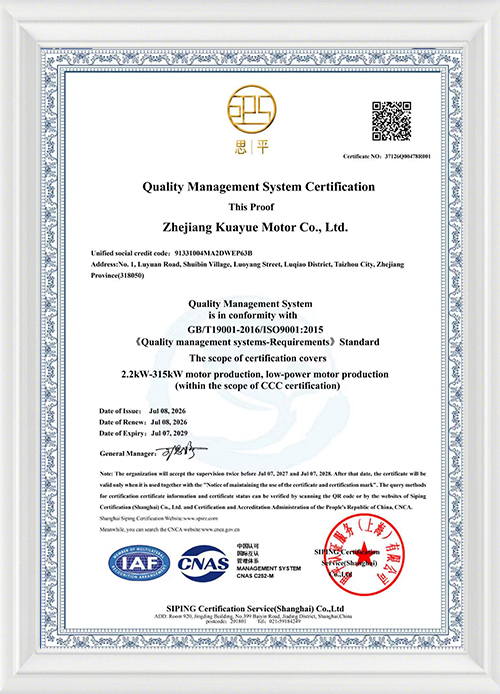
Manufactured under an ISO9001 quality-management system, the company's products hold China CCC compulsory certification and EU CE certification. Its motors are sold across more than 20 Chinese provinces and exported to Europe, America, Southeast Asia, the Middle East and other global regions, serving mining, chemical, pump and HVAC, textile, lifting, machine-tool and port-construction machinery applications.
7. Common Questions About Variable-Frequency Brake Motors
Q1. What is a variable frequency brake motor?
A variable frequency brake motor is an induction motor designed for VFD speed control with an integrated electromagnetic brake. The VFD regulates motor speed, while the brake provides rapid stopping or holding. It is commonly used where both continuous speed adjustment and controlled stopping are required.
Q2. How does a variable frequency brake motor work?
The VFD changes motor frequency and voltage to control shaft speed. The electromagnetic brake is independently controlled so it releases during operation and engages when the stopping command or power-loss condition requires braking. Correct synchronization between motor control and brake control is essential.
Q3. What is the difference between a brake motor and a standard motor?
A standard motor provides driving torque but normally has no integrated mechanical holding brake. A brake motor adds an electromagnetic braking system, allowing the shaft to stop quickly and remain held when the brake is engaged. For industrial automation, this can simplify machine design and improve stopping control.
Q4. What is the difference between a VFD motor and a brake motor?
A VFD motor is optimized for operation with an inverter and variable frequency. A brake motor adds an electromagnetic brake. A variable-frequency brake motor combines both functions, making it appropriate when the machine requires adjustable speed plus rapid stopping or holding.
Q5. What is an electromagnetic brake motor?
An electromagnetic brake motor uses an electrically controlled brake, commonly mounted at the non-driving end of the motor. Depending on its design, the brake releases when energized and applies through spring force when power is removed. Buyers should verify brake torque, voltage, response time and duty cycle with the manufacturer.
Q6. What is an inverter duty brake motor?
An inverter duty brake motor is designed to operate reliably from a VFD while also providing mechanical braking. Compared with a general-purpose motor, the design typically pays greater attention to insulation, thermal management and operation over a variable frequency range. For industrial OEM projects, the motor and VFD should be specified as a complete system rather than selected independently.


 English
 Español
 عربى
عربى