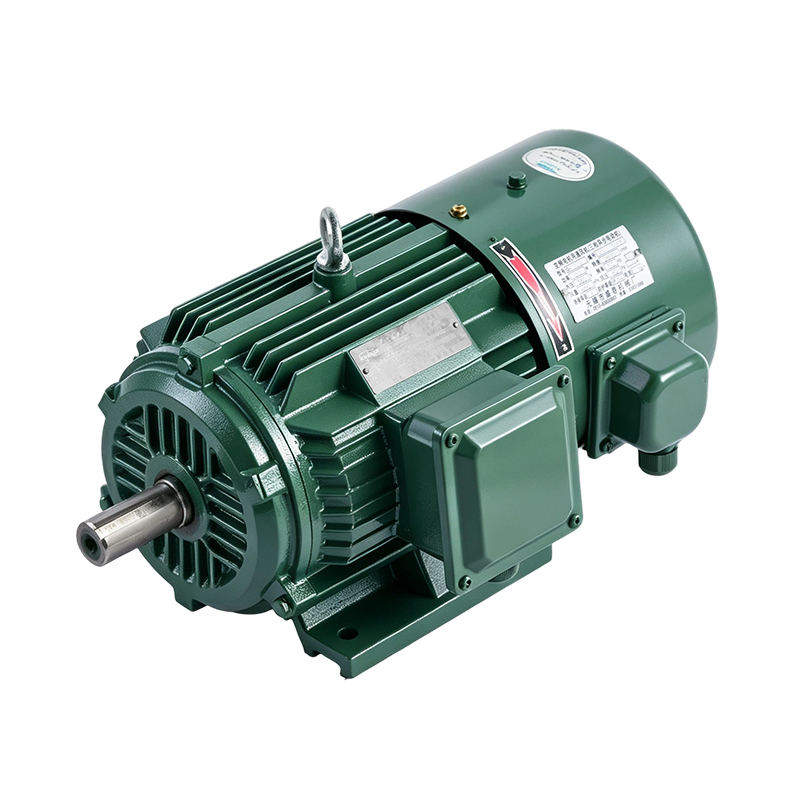
YVF2 Variable-Frequency Motors are three-phase asynchronous motors designed to operate with variable frequency drives (VFDs) for adjustable-speed industrial applications. Unlike a conventional fixed-speed motor, a yvf2 variable frequency motor allows the operating speed to be changed by adjusting the frequency supplied by the inverter. This makes the YVF2 motor suitable for pumps, fans, compressors, conveyors, machine tools, textile machinery, lifting equipment, mining systems, and other industrial equipment requiring flexible speed control.
For B2B buyers, the key advantages are controllable speed, smoother starting, improved process flexibility, and better matching between motor output and actual machine demand. Current IEC efficiency requirements have also become more important: IEC 60034-30-1:2025 introduced IE5 efficiency classification for applicable line-operated AC motors, so buyers should evaluate motor efficiency together with the complete motor-drive system rather than selecting a motor based only on rated power.
2. What Is a YVF2 Variable Frequency Motor?
(1) Definition and Operating Principle
A yvf2 variable frequency motors system normally consists of a three-phase induction motor and a frequency converter. The converter changes the output frequency and voltage according to the required operating condition. Because synchronous speed is related to supply frequency, changing frequency enables the motor to operate at different speeds.
For a typical 4-pole motor supplied at 50 Hz, the theoretical synchronous speed is 1,500 rpm, while practical rated speed is usually around 1,450–1,490 rpm because of slip. When the frequency is reduced, motor speed decreases correspondingly. At higher frequencies, speed can increase if the motor, inverter, bearings, cooling system, and driven machine are rated for that condition.
(2) Why YVF2 Motors Are Different
A yvf2 motor is specifically enhanced for frequency conversion. Compared with many standard fixed-frequency motors, the design can incorporate improved insulation, enhanced heat dissipation, and stronger mechanical construction. These features are important because inverter operation can introduce additional electrical stress, harmonics, and different thermal conditions.
3. YVF2 Electric Motor Specifications and Selection Data
Typical YVF2 series products cover a broad industrial power range. The following examples illustrate commonly available 4-pole configurations; exact ratings, efficiency, frequency range, and speed limits vary by manufacturer and design.
Typical reference data for selected YVF2 three-phase motors. Confirm final specifications with the manufacturer.
| Model Example |
Power |
Typical Rated Speed |
Typical Application |
| YVF2-132M-4 |
7.5 kW |
About 1,445 rpm |
Pumps, fans, conveyors |
| YVF2-200L-4 |
30 kW |
About 1,470 rpm |
Industrial drives |
| YVF2-280M-4 |
90 kW |
About 1,485 rpm |
Fans, pumps, compressors |
| YVF2-355L-4 |
315 kW |
About 1,490 rpm |
Heavy industrial machinery |
A commonly specified YVF2 product range is 0.55 kW to 315 kW, with 4-pole operating speeds commonly around 1,500 rpm at 50 Hz. Some manufacturers offer wider frequency ranges and speed capabilities, but the actual allowable range should always be checked against the motor's datasheet and inverter settings.
4. Applications of YVF2 Three Phase Motors
(1) Pumps and HVAC Systems
A yvf2 three phase motor is widely used for centrifugal pumps, ventilation fans, air-handling equipment, and HVAC systems. Variable speed allows equipment output to follow actual demand instead of continuously operating at full speed.
(2) Conveyors, Textile and Machine Tools
In conveyor systems, a yvf2 variable speed motor can provide controlled acceleration and adjustable production speed. Textile machines and machine tools also benefit from stable speed regulation, particularly where process quality depends on maintaining a defined operating speed.
(3) Mining, Lifting and Heavy Machinery
For mining conveyors, lifting systems, crushers, and port machinery, a yvf2 ac motor can be paired with an inverter to control starting, acceleration, and operating speed. For demanding loads, buyers should verify starting torque, overload capability, cooling performance, braking requirements, and duty cycle before placing an order.
5. How to Choose a YVF2 Motor Manufacturer
For industrial procurement, selecting a supplier involves more than comparing unit prices. A reliable yvf2 three phase asynchronous motor supplier should provide complete technical documentation, production traceability, test data, compatible mounting dimensions, and clear warranty terms.
- Confirm rated power, voltage, frequency, poles, mounting type, protection rating, and insulation class.
- Check the required inverter frequency range and continuous operating speed.
- Request efficiency, current, torque, noise, vibration, and temperature-rise data.
- Verify certifications and quality-management systems required by the destination market.
- Evaluate OEM capability, minimum order quantity, lead time, spare parts, and after-sales support.
6. Kuayue Motor Co., Ltd: YVF2 Motor Manufacturer and OEM Factory
Variable-frequency motors are three-phase asynchronous motors specifically engineered for use with electronic frequency converters. Compared to standard motors, they feature targeted enhancements in insulation, heat dissipation, and mechanical strength, enabling stepless speed regulation within a range of 150~2750 RPM (4-pole). Power output covers 0.55kW to 315kW, making this the core power solution for applications requiring flexible, adjustable speed rather than a fixed output.
Kuayue Motor Co., Ltd is a YVF2 variable-frequency motor manufacturer and OEM factory in China, offering custom motors for efficient speed control in various industrial applications.
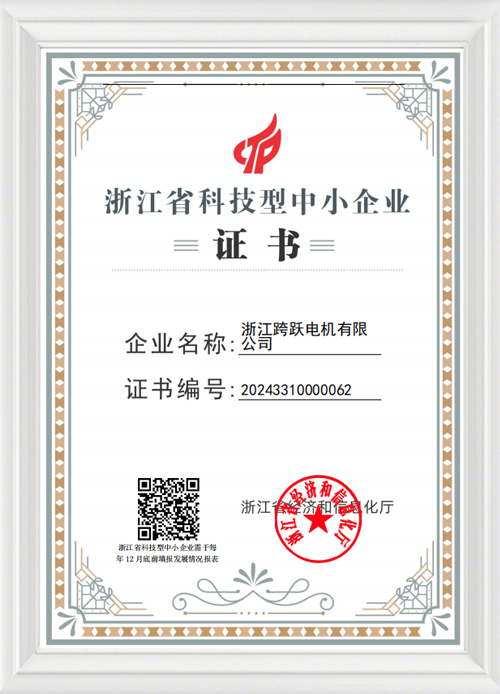
Zhejiang Kuayue Motor Co., Ltd. is an export-oriented manufacturer integrating R&D, production, sales, and export. Located in Luqiao District, Taizhou City, Zhejiang Province, the company has accumulated 34 years of experience in the motor industry. Its production base covers 29 mu and has more than 30 staff members.
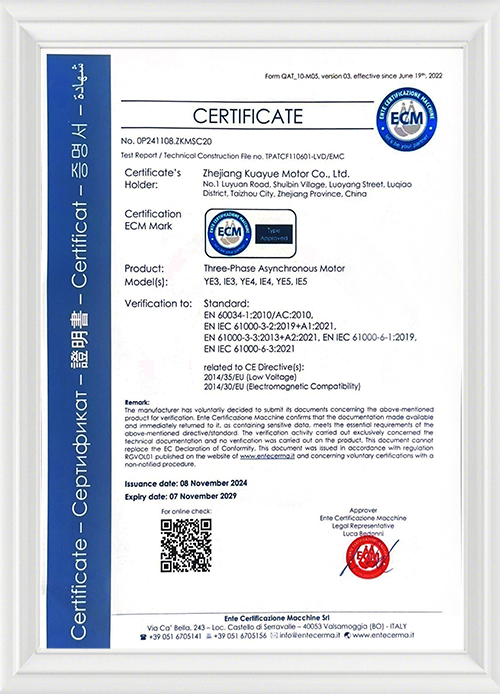
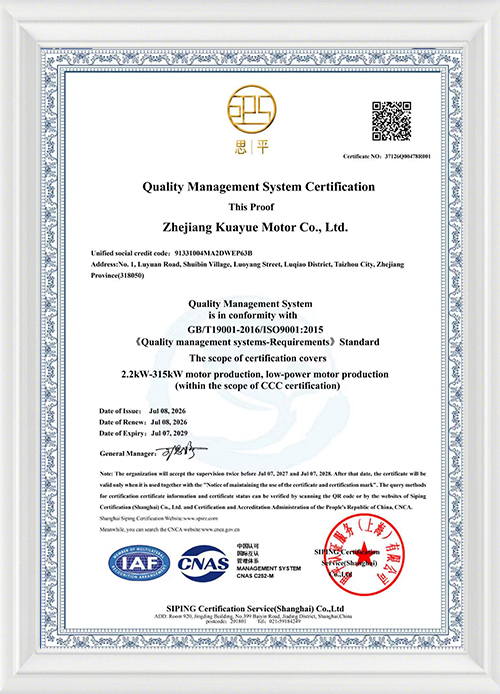
Manufactured under an ISO9001 quality-management system, the company's products hold China CCC compulsory certification and EU CE certification. Its motors are sold across more than 20 Chinese provinces and exported to Europe, America, Southeast Asia, the Middle East, and other global markets. Applications include mining, chemical processing, pumps and HVAC, textile machinery, lifting equipment, machine tools, and port-construction machinery.
7. YVF2 Induction Motor Efficiency and VFD Matching
A yvf2 induction motor should be evaluated as part of a complete power-drive system. Motor efficiency is important, but inverter losses, cable losses, harmonics, load profile, and operating speed can also affect total energy consumption. IEC 60034-30-1:2025 now includes IE5 efficiency classification for applicable single-speed AC motors, while complete power-drive-system efficiency is addressed separately by the IEC 61800 series.
For example, if a 90 kW motor operates continuously at a lower process load, using a VFD to reduce speed may produce a substantial energy advantage compared with throttling a pump or fan mechanically. The actual saving depends on the machine's load curve, so B2B buyers should request an application-based energy calculation rather than assuming a fixed percentage.
Key parameters to confirm before purchasing a YVF2 motor for VFD operation.
| Parameter |
Why It Matters |
| Power and Torque |
Ensures the motor can handle the actual machine load. |
| Frequency Range |
Defines the usable speed-control range. |
| Cooling Method |
Low-speed operation may reduce self-cooling performance. |
| Insulation System |
Helps withstand inverter-related electrical stress. |
| Bearings and Shaft |
Important for high-speed and demanding continuous-duty applications. |
Q1. What is a YVF2 motor?
A YVF2 motor is a three-phase asynchronous motor designed for variable-frequency speed regulation. It is normally used with a frequency converter to adjust motor speed according to industrial process requirements. Compared with a conventional fixed-speed motor, its electrical insulation, thermal management, and mechanical design are optimized for inverter-driven operation.
Q2. What is a variable frequency motor?
A variable frequency motor is an AC motor intended to operate with changing supply frequency. A VFD adjusts frequency and voltage to control motor speed and torque. This configuration is widely used in pumps, fans, conveyors, compressors, machine tools, textile equipment, and other industrial machinery.
Q3. How does a YVF2 motor work?
The inverter converts incoming electrical power into a controlled three-phase output. By changing frequency, it changes the rotating magnetic field speed inside the motor. The motor then follows the commanded operating speed while producing the torque required by the connected machine. Correct VFD programming and motor parameter settings are essential for stable operation.
Q4. What is the difference between YVF2 and a standard motor?
The main difference is the intended operating condition. A standard motor is commonly designed around fixed-frequency mains operation, while a YVF2 motor is designed for frequency-converter applications. YVF2 construction may include enhanced insulation and cooling provisions to better handle variable speed, inverter voltage stress, and additional heating caused by harmonic components.
Q5. What applications are YVF2 motors used for?
Typical applications include water pumps, HVAC fans, compressors, conveyors, textile machinery, machine tools, mining equipment, lifting machinery, chemical equipment, and port machinery. They are particularly valuable where production speed, flow, pressure, or torque needs to be adjusted during operation.
Q6. Where can I buy YVF2 motors?
B2B buyers can purchase YVF2 motors directly from specialized manufacturers and OEM factories. When sourcing internationally, compare technical specifications, certifications, production capacity, customization options, lead time, packaging, warranty, and after-sales support instead of comparing price alone. For projects requiring large quantities or customized mounting and electrical specifications, direct factory sourcing can provide greater flexibility.
Q7. How much does a YVF2 motor cost?
YVF2 motor prices vary according to power, frame size, efficiency, voltage, frequency range, cooling method, quantity, certifications, and customization. A 7.5 kW motor and a 315 kW motor have very different production and logistics costs. For accurate B2B pricing, buyers should provide the required power, voltage, frequency, poles, mounting type, quantity, destination, and required certifications.
Q8. How do I choose a YVF2 motor manufacturer?
Choose a manufacturer that can provide complete datasheets, test reports, stable production quality, OEM support, relevant certifications, and export experience. For recurring procurement, also evaluate production capacity, quality-control procedures, spare-parts availability, delivery performance, and communication efficiency. A factory with established experience in industrial applications is generally better positioned to support customized projects.
Q9. What certifications are available for YVF2 motors?
Certification depends on the manufacturer and target market. Common requirements may include ISO 9001 quality-management certification, China CCC certification, and EU CE requirements. Buyers exporting to specific countries should confirm the exact applicable standards and documentation before purchase because certification requirements can vary by market, application, and voltage.
Q10. Can a YVF2 variable speed motor run at very low speed continuously?
It depends on the motor's cooling method, load torque, duty cycle, and manufacturer-approved frequency range. At low speed, a self-cooled motor may move less cooling air, increasing temperature rise. For continuous low-speed operation, buyers should confirm thermal performance and determine whether independent forced ventilation or another cooling solution is required.


 English
 Español
 عربى
عربى