Quickly find the product you need.

Content
An Industrial Pump is a mechanical device that moves liquid through a pipeline by converting rotational or reciprocating mechanical energy into fluid flow and pressure. In most factories, buildings, and municipal systems, this job is done by a centrifugal pump, where a spinning impeller pushes liquid outward into a volute casing, or by a positive displacement pump, where a fixed volume of liquid is physically trapped and pushed forward with each cycle.
When the same style of pump is installed directly in a pipe run to move water or another process fluid from one point to another, it is commonly referred to as an Industrial Pipeline Pump, or simply a Pipeline Pump. These terms describe the installation role rather than a separate mechanical category, since the same centrifugal or self-priming pump body can serve as a pipeline pump in a building water supply system, a fire protection network, or a chemical transfer line.
The sections below cover the main pump types, how a centrifugal pump works internally, how to calculate flow rate and head, energy efficiency, common industrial pipeline pump applications, and the practical factors worth checking when working through an industrial pump selection guide.
Industrial pumps are generally grouped into two broad mechanical families, with several sub types built for specific installation needs.
A centrifugal pump uses a rotating impeller to accelerate liquid outward, converting kinetic energy into pressure as the fluid moves through the volute casing. This is the most common industrial pump type because of its simple construction, continuous flow output, and suitability for low to medium viscosity liquids such as clean water, treated water, and many process fluids.
A positive displacement pump moves a fixed volume of liquid with each rotation or stroke, using gears, lobes, diaphragms, or pistons. This design delivers a more consistent flow rate regardless of discharge pressure and handles thicker or more viscous fluids better than a standard centrifugal design.
A self-priming pump is a centrifugal design built with an internal chamber that retains enough liquid to remove air from the suction line without external priming equipment, which makes it a practical choice for agricultural irrigation intake, drainage, and other applications where the source liquid level can vary.
| Pump Type | Flow Behavior | Typical Fit |
|---|---|---|
| Centrifugal | Continuous, varies with pressure | Water supply, HVAC circulation, pipeline transfer |
| Positive Displacement | Fixed volume per cycle, steady output | Viscous or metered chemical transfer |
| Self-Priming | Continuous once primed | Irrigation intake, drainage, variable source level |
Liquid enters the pump through the suction port at the center of the spinning impeller. As the impeller rotates, centrifugal force throws the liquid outward toward the edge of the impeller blades, increasing its velocity. The volute casing surrounding the impeller is shaped to gradually slow this fast moving liquid down, converting velocity into pressure before the liquid exits through the discharge port into the pipeline.
A mechanical seal keeps the pumped liquid from leaking along the rotating shaft where it passes through the pump housing, while bearings support the shaft and keep the impeller centered inside the casing. Because output pressure and flow rate are linked through this mechanism, every centrifugal pump has a performance curve that shows how head drops as flow rate increases.
General shape of a centrifugal pump performance curve, illustrative only, actual curves vary by model
Flow rate, often written as Q, is the volume of liquid a pump moves over a given time, typically expressed in cubic meters per hour (m3/h). It can be measured directly with a flow meter on the discharge line, or estimated by timing how long it takes the pump to fill a container of known volume during a test run.
Total head is the sum of static head, the vertical lift between the source and discharge point, and friction head, the pressure lost to resistance inside the pipe, fittings and valves. A basic estimate is: Total Head = Static Head + Friction Head + Pressure Head at the discharge point. Larger pipe diameters and shorter, straighter runs generally reduce friction head for the same flow rate.
A pipeline centrifugal pump relies on a small set of core parts that determine its reliability and service life.
Structural diagram of a typical pipeline centrifugal pump
Many industrial pipeline pumps use a ceramic mechanical seal chosen for resistance to corrosion, mild alkali exposure, and elevated temperature, which extends service life when handling treated water, condensate, or mildly aggressive process fluids compared with a basic rubber lip seal.
The shaft transmits rotational force from the motor to the impeller, supported by bearings that keep radial and axial movement within a narrow tolerance so the impeller does not rub against the casing during operation.
Industrial pipeline pumps are generally sold across a family of models sized for different duty points rather than as a single fixed size. A common pipeline centrifugal and self-priming pump range spans a flow rate of 5.2 to 160 m3/h, a head range of 10 to 110 meters, and a matching motor power output of 0.75 kW to 55 kW, which allows the same product family to cover small building booster duty up through larger industrial and municipal transfer duty.
Illustrative breakdown of a 5.2 to 160 m3/h pump family across three duty bands
| Parameter | Typical Range |
|---|---|
| Flow rate | 5.2 to 160 m3/h |
| Head | 10 to 110 meters |
| Motor power | 0.75 kW to 55 kW |
Pump efficiency describes how much of the input motor energy is converted into useful hydraulic work, and it changes across the flow range of a given pump rather than staying fixed at one number. Running a pump too far to the left or right of its best efficiency point on the performance curve is a common cause of unnecessary energy use, according to general pump engineering references on system sizing.
Centrifugal pump efficiency and other industrial pump energy efficiency figures are generally strongest near the middle of the flow range printed on the pump curve, which is why matching pump size to actual system demand, rather than oversizing for a worst case scenario, is one of the most effective ways to control long term running cost.
General efficiency band comparison across pump types, illustrative and not model specific
The difference between centrifugal and positive displacement pumps comes down to how each one moves liquid, which affects the applications each is generally best suited for.
General functional comparison based on typical design characteristics, illustrative only
An industrial pipeline pump is usually installed directly in line with the piping network it serves, and the same core pump family can cover several distinct duty points around a facility.
| Application | Typical Pump Role |
|---|---|
| Building water supply pressurization | Booster duty to maintain pressure at upper floors |
| HVAC chilled and hot water circulation | Continuous circulation between chiller and coils |
| Fire protection network | Pressure boosting to meet system demand |
| Boiler feed water | Transfer of treated water into the boiler system |
| Industrial and mining drainage | Self-priming intake and discharge of site water |
A chemical pump, sometimes called a chemical process pump or chemical transfer pump, moves media that is more aggressive than clean water, so material selection and seal design matter more than in a general water pipeline pump. Ceramic mechanical seals and corrosion resistant wetted parts are common choices for chemical and pharmaceutical media transport, since they hold up better against mild alkali exposure and elevated temperature than standard rubber seals.
When a pipeline pump is being considered for chemical process pump duty, it is worth confirming the wetted material compatibility with the specific fluid, the maximum allowable temperature, and whether the flow needs to stay constant regardless of small pressure changes, since that last point may point toward a positive displacement design instead of a standard centrifugal pump.
Working through a short, structured checklist is a practical way to select a pump for a given application without missing an important variable.
Beyond the technical specification sheet, a few practical points are worth confirming when comparing an industrial pump manufacturer.
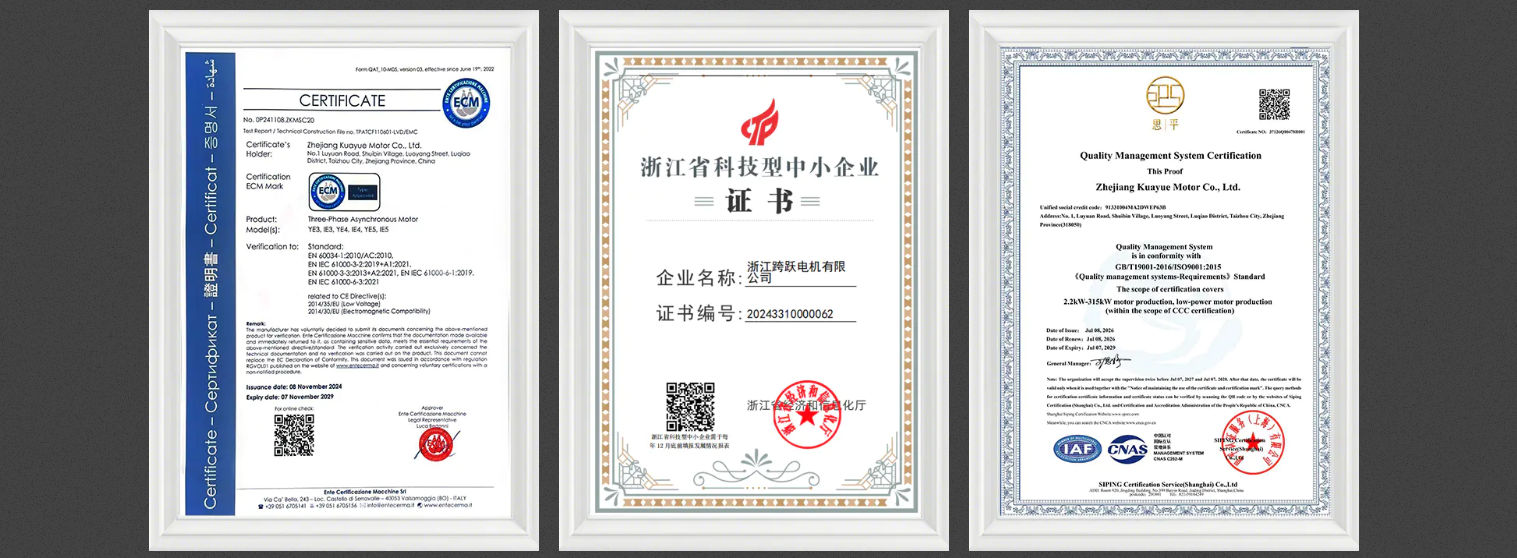
Zhejiang Kuayue Motor Co., Ltd. is an export oriented manufacturer covering research and development, production, sales, and export, based in Luqiao District, Taizhou City, Zhejiang Province, with 34 years of experience in the motor industry. The production base covers 29 mu and supports a team of more than 30 staff members.
As a custom industrial pump manufacturer and industrial pipeline pump company, Zhejiang Kuayue Motor supplies three phase asynchronous motors and industrial pump solutions, including pipeline centrifugal pumps and self-priming clean water pumps, with ODM and OEM customization services for buyers with specific project requirements. Motors and pumps are supplied across more than 20 Chinese provinces and exported to Europe, the Americas, Southeast Asia, the Middle East, and other regions, serving industries such as mining, chemical processing, pump and HVAC systems, textile, lifting equipment, machine tools, and port construction machinery.
What is an industrial pumpIt is a mechanical device that moves liquid through a system by converting rotational or reciprocating energy into fluid flow and pressure. |
What are industrial pumps used forThey are used for water supply, HVAC circulation, fire protection boosting, boiler feed water, chemical transfer, irrigation, and general drainage duty. |
What are the different types of industrial pumpsThe main families are centrifugal pumps, positive displacement pumps, and self-priming pumps, each suited to different flow and fluid handling needs. |
How does an industrial pump workA centrifugal pump spins an impeller to accelerate liquid outward into a volute casing, converting velocity into pressure as the liquid exits toward the pipeline. |
What is the most common industrial pumpThe centrifugal pump is the most common type due to its simple construction, continuous output, and suitability for water and many general process fluids. |
What is the difference between centrifugal and positive displacement pumpsA centrifugal pump produces continuous flow that varies with pressure, while a positive displacement pump moves a fixed volume per cycle for a steadier flow rate. |
How do I choose an industrial pumpStart with the required flow rate and head, then check fluid compatibility, motor power at the duty point, and whether self-priming capability is needed. |
How do I select a pump for my applicationMatch the pump curve to your system flow and head requirement, confirm wetted material suits the fluid, and size the motor to the actual duty point. |
What factors should I consider when selecting a pumpKey factors include flow rate, head, fluid type and temperature, seal material, duty cycle, and whether the installation needs self-priming operation. |
How do I calculate pump flow rateFlow rate can be measured with a flow meter on the discharge line, or estimated by timing how long the pump takes to fill a container of known volume. |
How do I calculate pump headTotal head is generally estimated as static head plus friction head plus pressure head at the discharge point, based on the pipe layout and fittings used. |
What is a pipeline pumpA pipeline pump is an industrial pump installed directly in line with a piping network to move or boost the pressure of the fluid running through that system. |



 English
 Español
 عربى
عربى