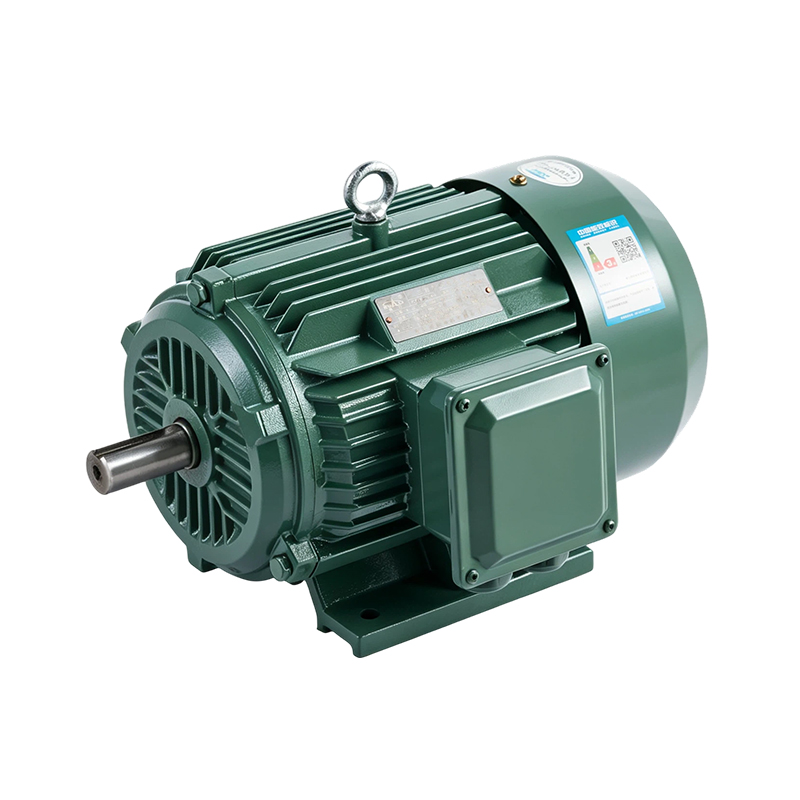
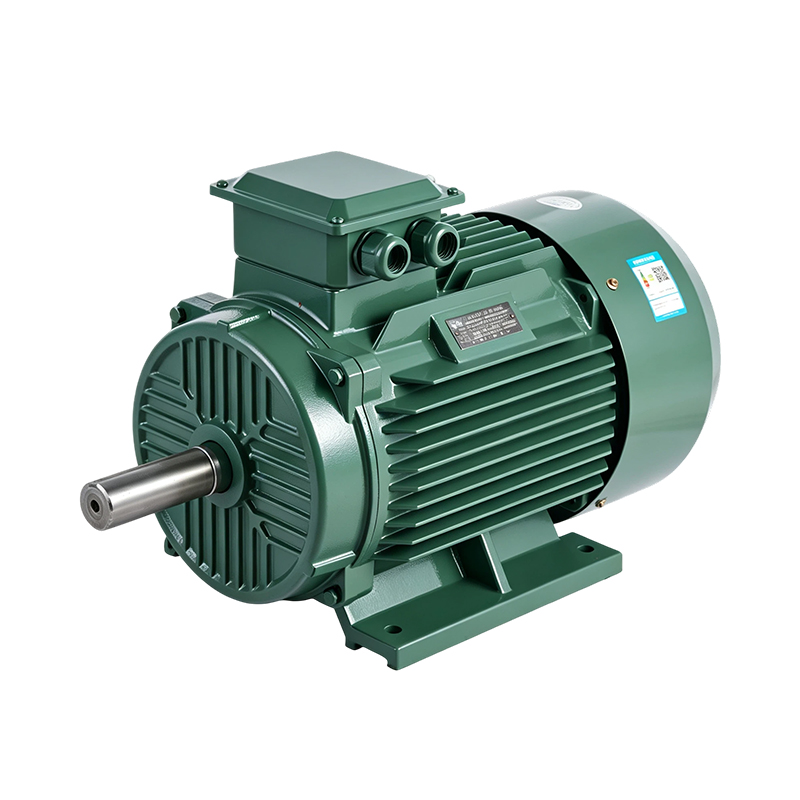
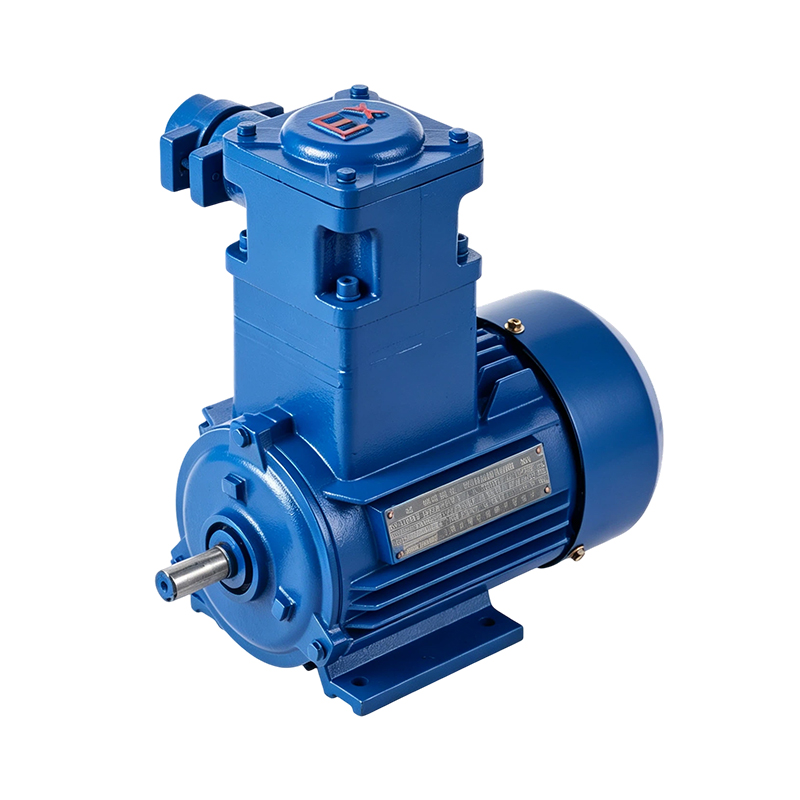
Quickly find the product you need.

A 15 kW pump motor on a 400 V, 50 Hz supply trips the breaker on every cold start, even though the nameplate rating matches the duty point. In most cases the motor is neither oversized nor undersized: the starting current, the actual busbar voltage and the protection curve simply no longer agree with each other. Locked-rotor current on a standard three-phase machine typically runs six to eight times rated current, according to IEC 60034-12 locked-rotor data, and that two-second surge decides whether the installation works.
The short answer behind that scenario: a low voltage induction motor is a squirrel-cage AC machine built for line voltages up to 1,000 V, and its suitability is decided by voltage, frequency, starting torque, efficiency class, enclosure and mounting, not by kilowatts alone.
This guide covers what "low voltage" actually includes, how IE efficiency classes change total cost of ownership, how starting methods shift torque, where these motors fail in service, and which checks belong on a purchase specification.
Content
IEC 60038 places the low voltage band at up to 1,000 V AC between conductors. North American practice draws the line at 600 V, which is why NEMA frame motors are catalogued as low voltage up to 575 V. Everything above that, such as 3.3 kV, 6 kV or 10 kV, is medium voltage and comes with a completely different cost structure for switchgear, cables and terminations.
In practice nearly every industrial LV motor is one of a handful of ratings: 380 V, 400 V or 415 V at 50 Hz, and 440 V, 460 V or 480 V at 60 Hz. IEC 60034-1 defines Zone A at ±5% voltage and ±2% frequency, with Zone B extending to ±10% voltage and +3% / −5% frequency. Outside those bands the motor still turns, but torque, temperature rise and efficiency no longer match the catalogue data.
| Nominal voltage | Frequency | Typical regions | Practical note |
|---|---|---|---|
| 230 V | 50 Hz | Europe, Asia, Africa (single-phase) | Small motors up to roughly 2-3 kW |
| 380 V | 50 Hz | China, parts of Asia | Legacy distribution; 400 V rated motors usually tolerate it |
| 400 V | 50 Hz | IEC Europe, Australia, most of Africa | The reference rating for IEC low voltage motors |
| 415 V | 50 Hz | United Kingdom, India, Gulf states | About 4% above 400 V, still inside IEC Zone A |
| 440 V | 60 Hz | Latin America, parts of Southeast Asia | Often used as the utilisation voltage on 480 V systems |
| 460 V | 60 Hz | North America (NEMA) | Standard utilisation voltage on 480 V distribution |
Two mistakes show up repeatedly on the buying side. The first is ordering a 380 V motor for a site whose measured voltage sits near 415 V, which pushes the magnetic circuit toward saturation and raises current. The second is running a 60 Hz motor at 50 Hz: synchronous speed drops by about 17%, the shaft-mounted fan moves less air, and usable shaft output usually has to be derated unless a drive holds a constant volts-per-hertz ratio.
IEC 60034-30-1 defines the IE1 to IE4 efficiency classes for line-fed induction motors, and the class on the nameplate affects total cost far more than the purchase price does. In the European Union, Regulation 2019/1781 has required IE3 as the minimum for most three-phase motors from 0.75 kW to 1,000 kW since July 2021, and extended IE4 to the 75-200 kW band for 2, 4 and 6-pole machines from July 2023. Comparable minimum efficiency rules apply in the United States, Canada, China, Brazil and Australia.
The step from IE3 to IE4 is not uniform. The gap in minimum efficiency is widest at small ratings, often two to three percentage points around 1 kW, and narrows to well under one point on large frames. That matters because the saving scales with running hours and load factor, not with the label.
For a motor running continuously at high load factor, energy dominates lifetime cost; the life-cycle cost models used in international motor efficiency programmes consistently place purchase price at a small fraction of the total. The practical rule is to specify the highest class the duty justifies, then confirm the driven equipment can actually use the extra efficiency. A pump running at 30% of its best-efficiency point wastes far more energy than any IE class upgrade can recover.
Torque, not efficiency, is what breaks installations. IEC 60034-12 groups squirrel-cage designs by locked-rotor characteristics: Design N for normal starting duty such as pumps and fans, and Design H for higher locked-rotor torque with low starting current, used on conveyors, crushers and positive-displacement loads. High starting torque is normally obtained with a deep-bar or double-cage rotor, which accepts higher slip and slightly lower full-load efficiency.
Direct-on-line starting is the cheapest option and the most demanding on the supply. Star-delta starting reduces current to roughly one third of the DOL value, but available starting torque falls by the same factor to about one third, a frequent reason a motor hums instead of accelerating a loaded conveyor. Soft starters trade a little torque for a controlled ramp, while a variable frequency drive removes the inrush problem by controlling voltage and frequency together.
Fans and centrifugal pumps follow the affinity laws: torque rises with the square of speed, so a drive on these loads saves energy quickly. Conveyors, extruders and positive-displacement pumps demand near-constant torque down to low speed and need forced ventilation or an inverter-rated motor. A standard TEFC motor running at 10 Hz on a drive will overheat, because its shaft-mounted fan no longer moves enough air across the frame.
Failure statistics consistently point at the bearings rather than the winding. A widely cited IEEE and EPRI motor reliability survey attributes roughly 41% of failures to bearings, about 37% to stator windings, near 10% to rotors and around 12% to everything else, including shaft, frame and terminals.
That distribution shapes maintenance practice. Bearing life shortens through misalignment, belt over-tension, incorrect grease volume and shaft currents on drive-fed motors. Winding failures follow moisture ingress, contamination, insulation age and voltage unbalance: NEMA MG-1 provides derating factors once unbalance exceeds 1%, because even a small negative-sequence component produces a disproportionate rise in rotor heating.
Enclosure and insulation choices are the cheapest protection available. IP55 is the standard choice for TEFC machines in dusty or damp plants, IP65 adds resistance to hose-directed water, and IP23 should stay indoors in clean air. Class F insulation with Class B temperature rise is common practice because it leaves thermal headroom for a 40 °C ambient and sites up to 1,000 m altitude; above those values output must be derated.
The exploded view below shows the parts that determine price and service life: the frame with cooling fins, the stator lamination stack with its winding, the rotor cage, the shaft, the terminal box, the cooling fan and cowl, and the mounting feet.
Frame material is a commercial decision as much as a technical one. Cast iron handles vibration and aggressive environments in chemical plants and is standard on larger frames; aluminium sheds heat well and cuts weight, which matters for pumps and portable equipment. Copper rotor cages appear mostly in IE4 and larger IE3 ratings, where the reduction in rotor loss justifies the extra cost.
Most specification errors surface in the first hour of commissioning rather than in the first year. These are the checks that prevent them.
Two purchasing risks deserve specific attention. First, a motor can meet an efficiency class on paper while the exact rating being delivered was never tested, so ask for test data for that output and pole count. Second, frame and shaft dimensions vary between manufacturers even at identical output, so a replacement should be specified by dimensions as well as by rating. Shaft straightness, keyway tolerance and flange run-out are the usual causes of a motor that fits but vibrates.
Manufacturers with in-house stamping, winding, machining and final test control those tolerances directly. Zhejiang Kuayue Motor, based in Taizhou, Zhejiang, has built small and medium industrial motors for 34 years and produces the YE3 (IE3) and YE4 (IE4) lines alongside YBX3 explosion-proof, YEJ2 electromagnetic brake, YVF2 inverter-duty and YD2 multi-speed series. Its motors are manufactured under ISO 9001 and carry CCC and CE certification, with shipments to customers across Europe, the Americas, Southeast Asia and the Middle East.



 English
 Español
 عربى