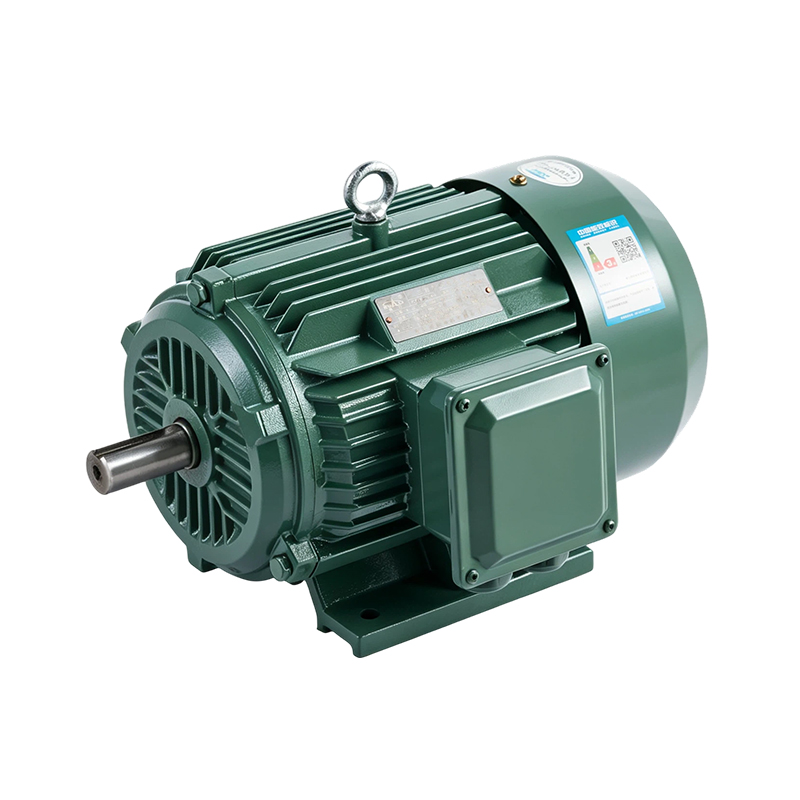
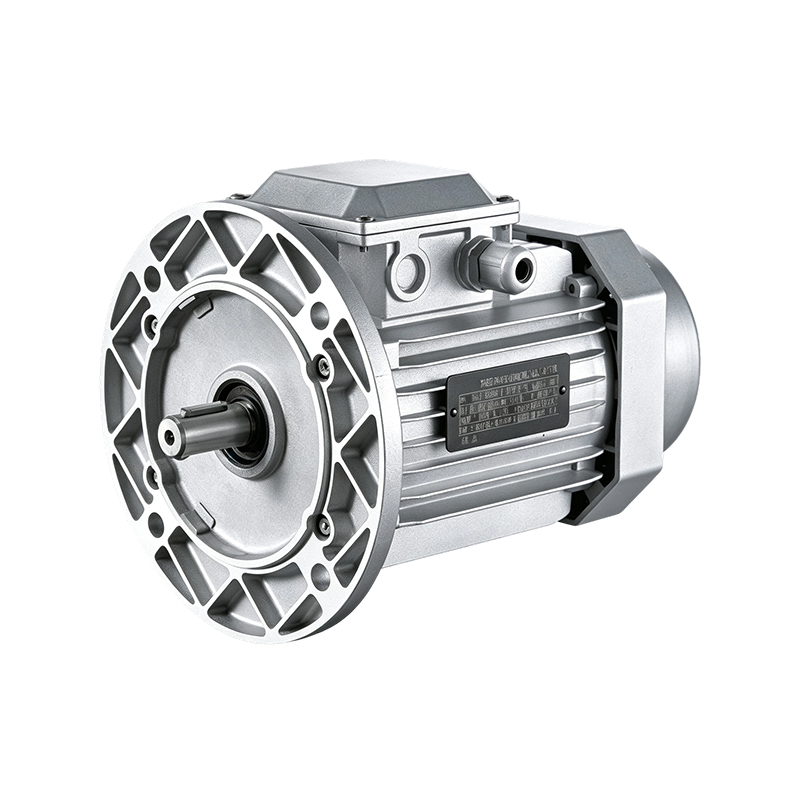
Quickly find the product you need.

A 15 kW, four-pole motor driving a process pump for 6,000 hours a year consumes roughly 100 MWh of electricity. Replacing it with an IE3 industrial motor of the same rating removes a little over 1,600 kWh from that total every year — about USD 160 at USD 0.10 per kWh, for as long as the motor stays on the shaft. That is the honest scale of the upgrade: not dramatic per unit, but predictable, cumulative, and earned back without touching the process.
Whether it is worth doing has less to do with the efficiency label than with three numbers: annual running hours, average load, and how badly the old motor was oversized. Machines that run 8,000 hours a year at 75–100% load return the premium within one to two years. Machines that run 800 hours a year on a lightly loaded conveyor frequently never do.
What follows covers what the IE3 class actually guarantees, where the losses were physically removed, how to compare IE3 with IE4 without overpaying, and which items belong on the purchase order before the motor leaves the factory.
Content
IE3 is a defined class, not a marketing phrase. IEC 60034-30-1 sets efficiency levels IE1 through IE5 for single-speed, three-phase induction motors from 0.75 kW to 1000 kW, in 2, 4, 6 and 8-pole versions, at both 50 Hz and 60 Hz, with losses determined under IEC 60034-2-1. IE3 sits at the "premium efficiency" step.
Two details matter at the buying stage. First, from IE3 upward the standard permits no negative tolerance: a motor badged IE3 must meet or exceed the table value rather than sit a few percent below it. Second, the 50 Hz and 60 Hz tables are separate, so a motor built for a 60 Hz market cannot be judged against 50 Hz figures.
Regulation has pushed IE3 from optional to baseline. EU Regulation 2019/1781 has required IE3 for most three-phase motors between 0.75 kW and 1000 kW since July 2021, and China's GB 18613-2020 grades IE3 as the minimum permitted level for many general-purpose ratings. For a replacement motor, IE3 is now the ordinary choice and IE2 stock is largely legacy.
| Rating (kW) | IE2 (%) | IE3 (%) | IE4 (%) | IE3 gain vs IE2 (points) |
|---|---|---|---|---|
| 0.75 | 79.6 | 82.5 | 85.7 | +2.9 |
| 1.5 | 82.8 | 85.3 | 88.2 | +2.5 |
| 4 | 86.6 | 88.6 | 91.1 | +2.0 |
| 7.5 | 88.7 | 90.4 | 92.6 | +1.7 |
| 15 | 90.6 | 92.1 | 94.0 | +1.5 |
| 30 | 92.3 | 93.6 | 95.4 | +1.3 |
| 55 | 93.5 | 94.6 | 96.1 | +1.1 |
| 110 | 94.5 | 95.4 | 96.6 | +0.9 |
Read the last column carefully. A gain of one to three points sounds marginal until it is converted into losses. A 15 kW motor at 92.1% draws 16.29 kW; the same shaft output at 90.6% draws 16.56 kW. That 0.27 kW is heat that no longer has to leave the winding — roughly 17% of total losses gone, which also lowers winding temperature and lengthens insulation life.
An induction motor loses energy in five places: stator copper (I²R), rotor copper, core magnetisation, stray load, and friction and windage. IE3 design generally attacks the first three — more copper in the slots, thinner and better-insulated laminations, a longer magnetic core, a tighter and more uniform air gap, and a fan profile that moves less air for the same cooling duty.
The practical consequence for a maintenance team is near-interchangeability with a different mass and a different sound. IE3 machines in the same frame are often a few kilograms heavier than their IE2 equivalents because of the additional active material, and the quieter fan can make an unfamiliar motor sound "wrong" to an operator used to the old one.
Efficiency is quoted at full load, and the curve is not flat everywhere. A typical IE3 motor holds close to its rated value down to about 60% load and then falls away; below roughly 40% load the advantage over a correctly sized smaller motor largely disappears. Two familiar mistakes follow from that.
Work from measured data wherever possible — clamp-meter readings over a normal production week, or the drive's own kWh log on pump and HVAC duties, where the load profile is usually stable and easy to read.
The step from IE3 to IE4 is much smaller than the step from IE2 to IE3 — about one to 1.7 percentage points — and it is usually bought with a different rotor technology: permanent-magnet or synchronous-reluctance designs rather than a plain squirrel cage. That changes the price, the control requirements and sometimes the retrofit envelope, because drives may need parameter sets or encoder feedback that a standard cage motor never asks for.
For a 110 kW machine at 8,000 hours a year, the last fraction of a point is real money; for a 4 kW fan at 1,500 hours it is noise. A closer look at torque behaviour, slip and drive compatibility between the two classes is set out in this IE3 vs IE4 comparison.
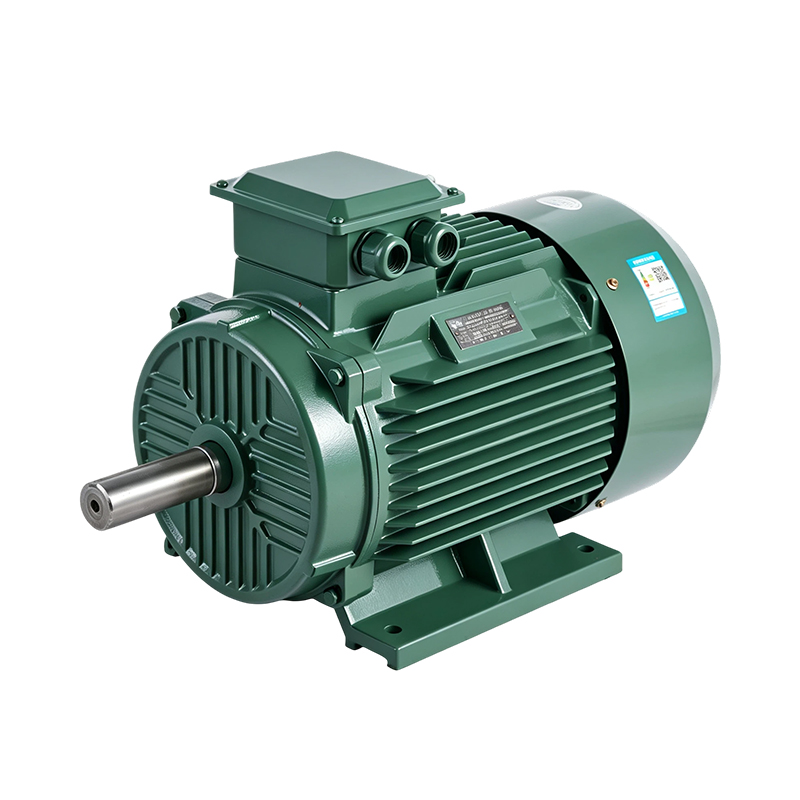 YE4/IE4 Ultra-High-Efficiency Three-Phase Motors, 0.75–375 kWCompare IE4 models across 2-, 4-, 6-, and 8-pole configurations, with cast-iron construction and IP55 protection for continuous industrial duty.View Product →
Where a site runs a mixed fleet and a maintenance budget rather than a capital budget, IE3 usually fits better: catalogue frames, no encoder, no special drive setup, and spares that any local workshop can source.
Pole count decides speed, and speed decides whether the motor actually suits the machine. At 50 Hz, a 2-pole motor runs near 2,900 rpm, a 4-pole near 1,450, a 6-pole near 950 and an 8-pole near 720. Choosing a higher pole count to gain torque almost always means a larger frame, so a 6-pole 15 kW is not a drop-in for a 4-pole 15 kW even at identical output.
Three checks belong in the enquiry before price is discussed:
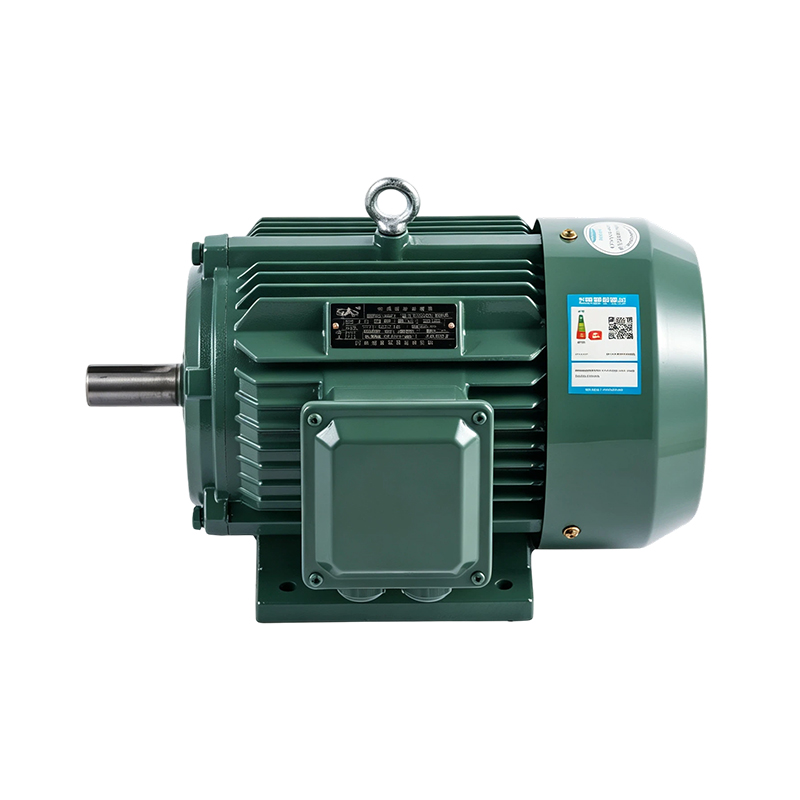 YE3/IE3 General-Purpose 4-Pole High-Efficiency Induction MotorCovers 0.55–315 kW with IP55 protection and Class F insulation, suited to pumps, compressors, conveyors, and standardized retrofit work.View Product →
Centrifugal pumps and fans are the most forgiving applications because load rises with the square of speed, so running hours dominate the calculation. The pump and HVAC solution pages show how the same series is specified for those duties, including the 4-pole general-purpose frame that covers most retrofit work.
A motor can be IE3 and still be wrong for a drive. Inverter output carries harmonic content and fast switching edges, so the winding needs insulation rated for it, and at low speed the shaft-mounted fan stops cooling effectively. Ask for the permitted speed range, the insulation class (F or H as standard), and whether an independent cooling fan is required below roughly 30 Hz.
For pumps and fans running long hours at part speed, a variable frequency motor paired with a drive usually saves more than the jump from IE2 to IE3, because the affinity laws cut power with the cube of speed while the efficiency class only trims a few percent. The two measures stack rather than compete.
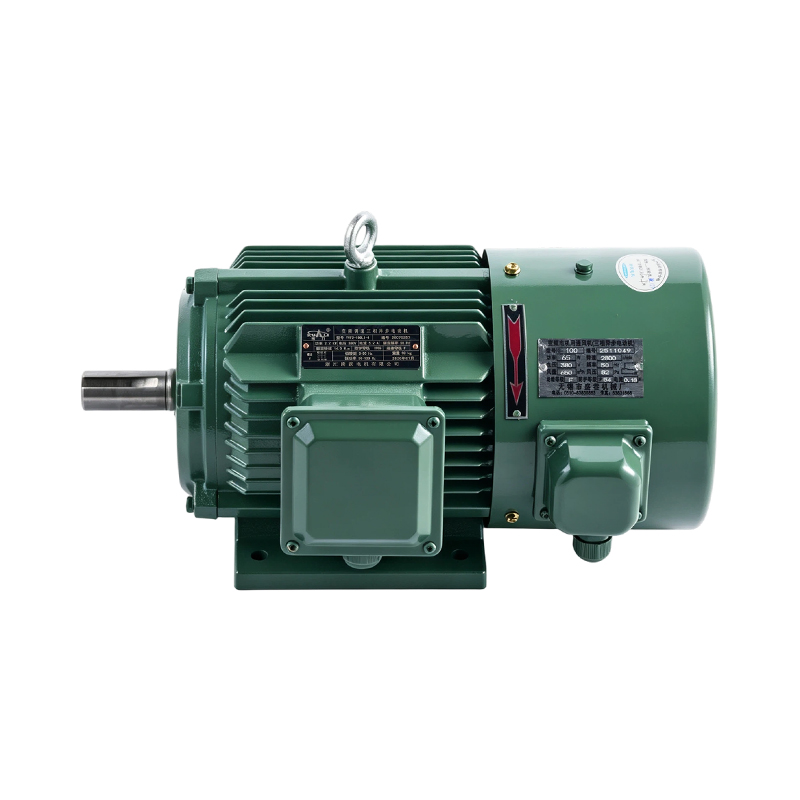 YVF2 General-Purpose Variable-Frequency Motor, 4-PoleCovers 150–2750 RPM with constant-torque and constant-power ranges, and is compatible with Y2 series for direct replacement in adjustable-speed duty.View Product →
Most warranty disputes on industrial motors begin with an incomplete specification, not a defective machine. The items below should appear on the datasheet, with the evidence that closes each one attached to the order.
| Check | Why it matters | Evidence to request |
|---|---|---|
| Efficiency at the rated point | The nameplate value must meet or exceed the IE3 table, with no negative tolerance | Test report to IEC 60034-2-1 |
| Voltage and frequency | 60 Hz values differ from 50 Hz; a 440 V / 60 Hz order cannot be judged on the 50 Hz table | Nameplate drawing |
| Insulation, ambient and altitude | VFD supply, ambient above 40 °C and sites above 1,000 m all derate output | Datasheet with derating curves |
| Frame and mounting | Shaft height, flange pattern and terminal box position decide whether it drops in | Dimension drawing |
| Ingress protection and area classification | IP55 covers most plant rooms; washdown, heavy dust or explosive atmospheres need more | IP rating and certificates |
| Bearings and lubrication | Regreasing interval and bearing type set the future maintenance load | Bearing designation list |
At commissioning, record no-load current, phase-to-phase resistance and vibration for each new motor and file the numbers with the equipment record. They become the baseline for every later comparison, and they are the quickest way to spot a motor that was rewound to a lower efficiency class during an emergency repair.
It is a three-phase asynchronous motor whose full-load efficiency meets the IE3 "premium efficiency" class in IEC 60034-30-1, normally covering 0.75–1000 kW across 2, 4, 6 and 8 poles at 50 Hz and 60 Hz.
At 15 kW and 4-pole, the loss difference is about 0.27 kW at full load, which is roughly 1,600 kWh a year at 6,000 running hours — less at partial load.
Yes, provided it is ordered for inverter duty: insulation rated for drive output, a defined speed range, and an independent cooling fan if it must run below about 30 Hz for long periods.
Above roughly 75 kW with long running hours, IE4 pays back; below 7.5 kW or under 2,000 hours a year, IE3 almost always wins on total cost of ownership.
They carry a premium over IE2 because of the extra copper and steel, but the gap has narrowed as IE3 became the regulated baseline for most general-purpose ratings.
Match the nameplate against the IEC table for its rating and frequency, request the routine test report, and confirm no-load current and vibration at commissioning.



 English
 Español
 عربى